


Page 552 - IJB-9-6
P. 552
International Journal of Bioprinting                            3D printing of PCL-ceramic composite scaffolds


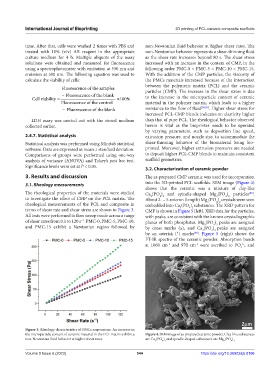
            time. After that, cells were washed 2 times with PBS and   non-Newtonian fluid behavior at higher shear rates. The
            treated with 10% (v/v) AB reagent in the appropriate   non-Newtonian behavior represents a shear-thinning fluid
            culture medium for 4  h. Multiple aliquots of the assay   as the shear rate increases beyond 80 s. The shear stress
            solutions were obtained and measured for fluorescence   increased with an increase in the content of CMP, in the
            using a spectrophotometer with excitation at 530 nm and   following order PMC-0 < PMC-5 < PMC-10 < PMC-15.
            emission at 590 nm. The following equation was used to   With the addition of the CMP particles, the viscosity of
            calculate the viability of cells:                  the PMCs materials increased because of the interaction
                                                               between the polymeric matrix (PCL) and the ceramic
                           Fluorescence of the samples         particles (CMP). The increase in the shear stress is due
                           − Fluorescence of the blank         to the increase in the microparticle content of ceramic
               Cell viability  =                   ×   100%
                           Fluorescence of the control         material in the polymer matrix, which leads to a higher
                            −    Fluorescence of the blank     resistance to the flow of fluid [58,59] . Higher shear stress for
                                                               increased PCL-CMP blends indicates an elasticity higher
              LDH assay was carried out with the stored medium   than that of pure PCL. The rheological behavior observed
            collected earlier.                                 herein is vital as the bioprinter needs to be operated
                                                               by varying parameters, such as deposition line speed,
            2.4.7. Statistical analysis                        extrusion pressure, and nozzle size, to accommodate the
            Statistical analysis was performed using Minitab statistical   shear-thinning behavior of the biomaterial being bio-
            software. Data are expressed as mean ± standard deviation.   printed. Moreover, higher extrusion pressures are needed
            Comparisons of groups were performed using one-way   to deposit higher PCL-CMP blends to maintain consistent
            analysis of variance (ANOVA) and Tukey’s post hoc test.   scaffold geometries.
            Significance levels were set at P < 0.05.          3.2. Characterization of ceramic powder

            3. Results and discussion                          The as-prepared CMP ceramic was used for incorporation
            3.1. Rheology measurements                         into the 3D-printed PCL scaffolds. SEM image (Figure 4)
                                                               shows that the ceramic was a mixture of clay-like
            The rheological properties of the materials were studied   Ca (PO )  and spindle-shaped Mg (PO )  particles .
                                                                                                           [60]
                                                                                                 4 2
                                                                 3
                                                                                             3
                                                                     4 2
            to investigate the effect of CMP on the PCL matrix. The   About 2- – 5-micron (length) Mg (PO )  crystals were seen
                                                                                             4 2
                                                                                         3
            rheological  measurements  of  the  PCL  and  composite  in   embedded into Ca (PO ) substances. The XRD pattern for
                                                                              3
                                                                                 4 2
            terms of shear rate and shear stress are shown in Figure 3.   CMP is shown in Figure 5 (left). XRD data for the particles,
            All tests were performed in flow sweep mode across a range   with peaks, are consistent with the known crystallographic
            of shear rates from 0.1 to 120 s . PMC-0, PMC-5, PMC-10,   planes of both phosphates. Mg (PO )  peaks are assigned
                                   −1
                                                                                            4 2
                                                                                        3
            and PMC-15 exhibit a Newtonian region followed by   by cross marks (x), and Ca (PO ) peaks are assigned
                                                                                           4 2
                                                                                       3
                                                               by an asterisk (*) marks .  Figure  5 (right) shows the
                                                                                    [60]
                                                               FT-IR spectra of the ceramic powder. Absorption bands
                                                               at  1060  cm   and 970  cm   were  ascribed  to  PO ,  and
                                                                                                        3-
                                                                        -1
                                                                                    -1
                                                                                                       4


            Figure 3. Rheology characteristics of PMCs suspensions. An increase in
            the microparticle content of ceramic material in the PCL matrix exhibit a   Figure 4. SEM image of as-prepared ceramic powder. Clay-like substances
            non-Newtonian fluid behavior at higher shear rates.  are Ca (PO ) and spindle-shaped substances are Mg (PO ) .
                                                                                                   4 2
                                                                   3
                                                                      4 2
                                                                                                3
            Volume 9 Issue 6 (2023)                        544                         https://doi.org/10.36922/ijb.0196

