


Page 555 - IJB-9-6
P. 555
International Journal of Bioprinting                            3D printing of PCL-ceramic composite scaffolds


            the composite scaffolds. The decreasing order of contact   3.6. Cell viability on 3D-printed scaffolds
            angle measurements with an increase of bio-ceramics   The  biocompatibility  of PMC-0 and  composite  scaffolds
            resembles well with decreasing trend as seen in PCL/HA   (PMC-5, PMC-10, and PMC-15) was tested by culturing
            composite scaffold structures . These results illustrate   NIH/3T3 cells for 3 days. Various literature has confirmed
                                    [59]
            that homogeneously mixed PMCs resulted in an enhanced   PCL’s non-toxic effect on 3T3 fibroblast cells [71,72] . Hence,
            hydrophilic scaffold, which can further improve the   PCL alone was used as a control compared to other
            cellular proliferation and adsorption of biochemical cues   compositions. In this experiment, all the scaffolds had an
            for orthopedic applications, as reported in our previous   average of more than 100% live cells at day 3 compared
            computational biochemical models [31,55] .
                                                               to the control one. According to the current ISO–10993, a
              Moreover, researchers can tune the hydrophilicity and   cell viability of greater than 75% can be regarded as non-
            cellular response by adjusting the amount of CMPs in the   toxic  for  medical  devices;  therefore,  in  our  experiment,
            scaffold structures. Furthermore, multi-nozzle deposition   we used a PCL-ceramic composition with more than 75%
            3D bioprinting can provide functionally gradient   cell viability as a safety criterion . Tukey’s post hoc test
                                                                                          [73]
            PMCs structures for osteochondral (bone-cartilage)   was performed with ANOVA for multiple comparisons.
            tissue constructs by manipulating material and process   The α-value was set to 0.05, and P < 0.05 was considered
            parameters. In the past, a variety of biological materials,   statistically significant. No statistically significant value
            including ECM, adhesion proteins, such as collagen,   regarding the cellular viability of the scaffolds was observed
            laminin, and fibronectin, as well as mucopolysaccharides,   within the groups for day 1. The cell viability of composite
            such as heparin sulfate, hyaluronate, and chondroitin   scaffolds was enhanced with an increase in ceramic
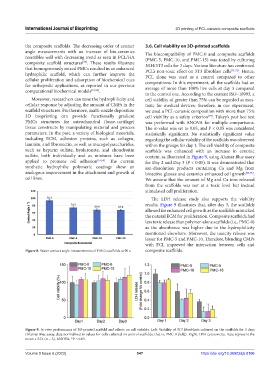
            sulfate, both individually and as mixtures have been   content, as illustrated in Figure 9, using Alamar Blue assay
            applied to promote cell adhesion [51,53] . The current   for Day 2 and Day 3 (P < 0.05). It was demonstrated that
            synthetic hydrophilic polymeric coatings show an   ion-dissolution products  containing  Ca and  Mg  from
            analogous improvement in the attachment and growth of   bioactive glasses and ceramics enhanced cell growth [74,75] .
            cell lines.                                        We assume that the amount of Mg and Ca ions released
                                                               from  the  scaffolds  was  not  at a  toxic  level but  instead
                                                               stimulated cell proliferation.
                                                                 The LDH release study also supports the viability
                                                               results. Figure 9 illustrates that, after day 3, the scaffolds
                                                               allowed for enhanced cell growth as the scaffolds mimicked
                                                               the natural ECM for proliferation. Composite scaffolds had
                                                               less toxic release than polymer-alone scaffolds (i.e., PMC-0)
                                                               as the absorbance was higher due to the hydrophilicity
                                                               mentioned elsewhere. Moreover, the toxicity release was
                                                               lesser for PMC-5 and PMC-10. Therefore, blending CMPs
                                                               with  PCL  improved  the  interaction  between  cells  and
            Figure 8. Water contact angle measurements of PMCs scaffolds at 90 s.  composite scaffolds.


            Figure 9. In vitro performance of 3D-printed scaffold and effects on cell viability. Left: Viability of 3T3 fibroblasts cultured on the scaffolds for 3 days
            (Alamar Blue assay, data normalized to values for cells cultured on control scaffolds, that is, PMC-0 [left]). Right: LDH cytotoxicity. Data represent the
            mean ± S.D. (n = 3), ANOVA, *P < 0.05.


            Volume 9 Issue 6 (2023)                        547                         https://doi.org/10.36922/ijb.0196

