


Page 554 - IJB-9-6
P. 554
International Journal of Bioprinting                            3D printing of PCL-ceramic composite scaffolds


            3.4. Porosity of scaffolds                         for facilitating the diffusion of nutrition, allowing cell

            The pore size and porosity of the 3D-printed scaffolds   migration, accelerating cell proliferation, and enabling
                                                                           [66-68]
            were calculated and are presented in Table 2. The virgin   vascularization  .  Thus,  our high-porosity scaffolds
            polymer PMC-0 had the largest pore size (~245 μm) and   provide  diffusion  and release pathways of  biological
            the highest porosity (50%), respectively. However, as the   molecules and nutrients for cellular migration and
            ceramic content within the scaffold increased, there was   proliferation [69,70] .
            a reduction in both the pore size and porosity. This can   3.5. Hydrophilicity behavior of scaffolds
            be attributed to the increase in ceramic loading within
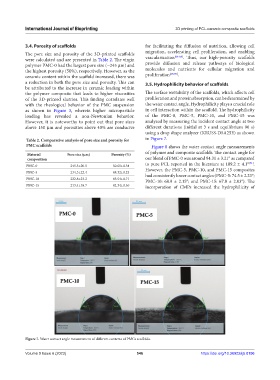
            the polymer composite that leads to higher viscosities   The surface wettability of the scaffolds, which affects cell
            of the 3D-printed slurries. This finding correlates well   proliferation and protein absorption, can be determined by
            with the rheological behavior of the PMC suspension   the water contact angle. Hydrophilicity plays a crucial role
            as shown in  Figure  3, wherein higher microparticle   in cell interaction within the scaffold. The hydrophilicity
            loading has revealed a non-Newtonian behavior.     of the PMC-0, PMC-5, PMC-10, and PMC-15 was
            However, it is noteworthy to point out that pore sizes   analyzed by measuring the incident contact angle at two
            above 150 μm and porosities above 40% are conducive   different durations (initial at 3 s and equilibrium 90 s)
                                                               using a drop shape analyzer (KRUSS-DSA25E) as shown
            Table 2. Comparative analysis of pore size and porosity for   in Figure 7.
            PMC scaffolds                                        Figure 8 shows the water contact angle measurements
                                                               of polymer and composite scaffolds. The contact angle for
             Material         Pore size (μm)    Porosity (%)
             composition                                       our blend of PMC-0 was around 94.31 ± 3.21° as compared
                                                                                                           [71]
            PMC-0              245.5±20.5        50.61±0.34    to pure PCL reported in the literature at 109.2 ± 4.1° .
            PMC-5              234.3±22.4        48.32±0.23    However, the PMC-5, PMC-10, and PMC-15 composites
                                                               had consistently lower contact angles (PMC-5: 74.5 ± 2.23°;
            PMC-10             222.8±23.2        45.54±0.71    PMC-10:  68.9 ± 2.15°; and PMC-15:  67.8 ± 2.03°). The
            PMC-15             213.4±18.7        42.34±0.56    incorporation of CMPs increased the hydrophilicity of


            Figure 7. Water contact angle measurement of different contents of PMCs scaffolds.


            Volume 9 Issue 6 (2023)                        546                         https://doi.org/10.36922/ijb.0196

