


Page 565 - IJB-9-6
P. 565
International Journal of Bioprinting                           Osteogenic, antibacterial CpTi-MgOCu implants


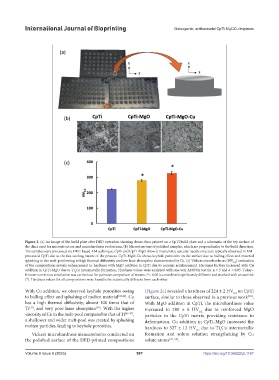
            Figure 2. (a) An image of the build plate after DED operation showing dense discs printed on a CpTi build plate and a schematic of the top surface of
            the discs used for microstructure and microhardness evaluations. (b) Microstructure of polished samples, which are perpendicular to the build direction.
            The samples were processed via DED-based AM technique. CpTi and CpTi-MgO show α’ martensitic acicular needle structure typically observed in AM-
            processed CpTi due to the fast cooling nature of the process. CpTi-MgO-Cu shows keyhole porosities on the surface due to balling effect and material
            splashing in the melt-pool owing to high thermal diffusivity and low laser absorption demonstrated by Cu. (c) Vickers microhardness (HV ) evaluation
                                                                                                     0.2
            of the compositions reveals enhancement in hardness with MgO addition in CpTi due to ceramic reinforcement. Hardness further increased with Cu
            addition in CpTi-MgO due to Ti Cu intermetallic formation. Hardness values were analyzed with one-way ANOVA test for n = 5 and α < 0.05. Tukey–
                                 2
            Kramer correction simulation was carried out for pairwise comparison of means. P < 0.05 is considered significantly different and marked with an asterisk
            (*). Hardness values for all compositions were found to be statistically different from each other.
            With Cu addition, we observed keyhole porosities owing   (Figure 2c) revealed a hardness of 224 ± 2 HV  on CpTi
                                                                                                     0.2
            to balling effect and splashing of molten material [43,44] . Cu   surface, similar to those observed in a previous work [48] .
            has a high thermal  diffusivity,  almost 100  times that  of   With MgO addition in CpTi, the microhardness value
            Ti , and very poor laser absorption . With the higher   increased to 280 ± 8 HV  due to reinforced MgO
              [43]
                                          [38]
                                                                                      0.2
            viscosity of Cu in the melt-pool compared to that of Ti [45-47] ,   particles in the CpTi matrix providing resistance to
            a shallower and wider melt-pool was created by splashing   deformation. Cu addition in CpTi-MgO increased the
            molten particles, leading to keyhole porosities.   hardness to 327 ± 12 HV  due to Ti Cu intermetallic
                                                                                               2
                                                                                     0.2
               Vickers microhardness measurements conducted on   formation  and solute  solution strengthening by Cu
            the polished surface of the DED-printed compositions   solute atoms [49, 50] .
            Volume 9 Issue 6 (2023)                        557                          https://doi.org/10.36922/ijb.1167

