


Page 568 - IJB-9-6
P. 568
International Journal of Bioprinting                           Osteogenic, antibacterial CpTi-MgOCu implants


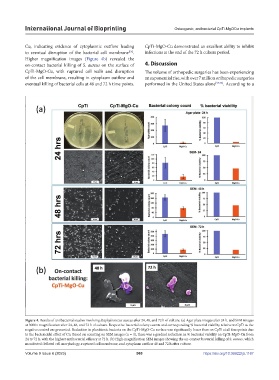
            Cu, indicating evidence of cytoplasmic outflow leading   CpTi-MgO-Cu demonstrated an excellent ability to inhibit
            to eventual disruption of the bacterial cell membrane .   infections at the end of the 72 h culture period.
                                                        [54]
            Higher magnification images (Figure 4b) revealed the
            on-contact bacterial killing of S. aureus on the surface of   4. Discussion
            CpTi-MgO-Cu, with ruptured cell walls and disruption   The volume of orthopedic surgeries has been experiencing
            of the cell membrane, resulting in cytoplasm outflow and   an exponential rise, with over 7 million orthopedic surgeries
            eventual killing of bacterial cells at 48 and 72 h time points.   performed in the United States alone [55,56] . According to a


            Figure 4. Results of antibacterial studies involving Staphylococcus aureus after 24, 48, and 72 h of culture. (a) Agar plate images after 24 h, and SEM images
            at 3000× magnification after 24, 48, and 72 h of culture. Respective bacterial colony counts and corresponding % bacterial viability relative to CpTi as the
            negative control are presented. Reduction in planktonic bacteria on the CpTi-MgO-Cu surface was significantly lower than on CpTi at all timepoints due
            to the bactericidal effect of Cu. Based on counting on SEM images (n = 4), there was a gradual reduction in % bacterial viability on CpTi-MgO-Cu from
            24 to 72 h, with the highest antibacterial efficacy at 72 h. (b) High-magnification SEM images showing the on-contact bacterial killing of S. aureus, which
            manifested deflated cell morphology, ruptured cell membrane, and cytoplasm outflow 48 and 72 h after culture.
            Volume 9 Issue 6 (2023)                        560                          https://doi.org/10.36922/ijb.1167

