


Page 562 - IJB-9-6
P. 562
International Journal of Bioprinting                           Osteogenic, antibacterial CpTi-MgOCu implants


            ensuring the implant’s long-term stability and preventing   and ceramic powers used were spherical. The fabrication
            the need for revision procedures due to their aseptic   used two AM processes: directed energy deposition
            loosening. This study  aims to  fabricate CpTi, CpTi +  1   (DED) and selective laser melting (SLM). Samples for
            wt.% MgO (CpTi-MgO), and CpTi + 1 wt.% MgO + 3     in vitro study were printed on a 5-axis DED-based AM
            wt.% Cu (CpTi-MgO-Cu) compositions using metal AM.   system (FormAlloy, Spring Valley, CA). Although coarser
            These compositions were characterized in terms of their   powder particles (45–150 µm) are preferred for DED-
            microstructure and microhardness. In vivo rat studies were   based AM systems, we optimized the printing parameters
            conducted to evaluate the biological performance of these   to accommodate finer particle size of <63 µm for the
            compositions. Structures utilized for the  in  vivo studies   printing operation. The printing operation was conducted
            were ~40 vol.% porous with an approximate pore size of   in an argon-purged environment with O  < 20 ppm in the
                                                                                               2
            600–700 µm since pore sizes in this range are optimum   printing chamber. A cold rolled CpTi substrate was used
            for enhanced tissue integration and osseointegration [35,36] .   as a build plate. Discs of 8 mm diameter and 4 mm height
            Additionally, in vitro bacterial culture was studied using   were printed on the DED system. The printing parameters
            the commonly occurring Staphylococcus aureus strain to   used for the compositions are presented in Table 1.
            evaluate the antibacterial efficacy of CpTi-MgO-Cu. We   Samples used for in vivo study were printed on an SLM-
            hypothesize that the CpTi-MgO-Cu composition will   based powder bed fusion system (3D Systems ProX  DMP
                                                                                                        ®
            demonstrate better osseointegration performance than   200, Rock Hill, SC, USA) with a 300 W fiber laser and a
            CpTi in vivo with no cytotoxicity due to the presence of   wavelength of λ = 1070 nm. Porous structures of 2.4 mm
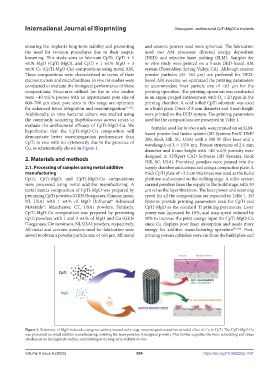
            Cu, as schematically shown in Figure 1.            diameter and 4 mm height with ~40 vol.% porosity were

            2. Materials and methods                           designed  in  3DXpert  CAD  Software  (3D  Systems,  Rock
                                                               Hill, SC, USA). Premixed powders were poured into the
            2.1. Processing of samples using metal additive    supply chamber and compacted using a compaction plate. A
            manufacturing                                      thick CpTi plate of ~2.5 cm thickness was used as the build
            CpTi,  CpTi-MgO,  and CpTi-MgO-Cu  compositions    platform and secured on the melting stage. A roller system
            were processed using metal additive manufacturing. A   carried powders from the supply to the build stage, with 30
            metal matrix composition of CpTi-MgO was prepared by   µm set as the layer thickness. The laser power and scanning
            premixing CpTi powders (GKN Hoeganaes, Cinnaminson,   speed for all the compositions are reported in Table 1. 3D
            NJ, USA) with 1 wt.% of MgO (Inframat® Advanced    Systems provide printing parameters used for CpTi and
            Materials™,  Manchester,  CT,  USA)  powders.  Similarly,   CpTi-MgO as the standard Ti printing parameters. Laser
            CpTi-MgO-Cu composition was prepared by premixing   power was increased by 10%, and scan speed reduced by
            CpTi powders with 1 and 3 wt.% of MgO and Cu (GKN   10% to increase the print energy input for CpTi-MgO-Cu
            Hoeganaes, Cinnaminson, NJ, USA) powders, respectively.   since Cu displays poor laser absorption and needs more
            All metal and ceramic powders used for fabrication were   energy for  additive  manufacturing operation [37,38] .  Post-
            sieved to obtain a powder particle size of <63 µm. All metal   printing porous cylinders were cut from the build plate and


            Figure 1. Schematic of MgO-induced osteogenic activity toward early-stage osseointegration and bactericidal effect of Cu in CpTi. The CpTi-MgO-Cu
            was processed via metal additive manufacturing, enabling the incorporation of designed porosity. This further expedites the bone remodeling and tissue
            attachment on the implant’s surface, contributing to its long-term stability in vivo.


            Volume 9 Issue 6 (2023)                        554                          https://doi.org/10.36922/ijb.1167

