


Page 202 - IJOCTA-15-1
P. 202
H.H. Yildirim, A. Akusta / IJOCTA, Vol.15, No.1, pp.183-201 (2025)
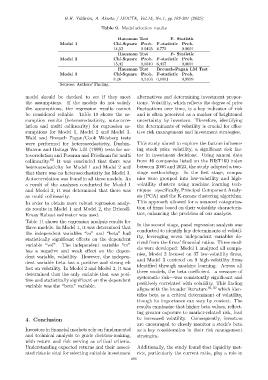
                                              Table 9. Model selection results

                                                     Hausman Test            F- Statistic
                            Model 1                Chi-Square Prob. F-statistic Prob.
                                                   14,53        0.0425 4.772      0.0001
                                                     Hausman Test            F- Statistic
                            Model 2                Chi-Square Prob. F-statistic Prob.
                                                   15,42        0,0310 6,437      0,0001
                                                     Hausman Test      Breusch-Pagan LM Test
                            Model 3                Chi-Square Prob. F-statistic Prob.
                                                   8.26         0,3103 0,0001     0,9999
                            Sources: Authors’ Finding.

            model should be checked to see if they meet       alternatives and determining investment propor-
            the assumptions. If the models do not satisfy     tions. Volatility, which reflects the degree of price
            the assumptions, the regression results cannot    fluctuations over time, is a key indicator of risk
            be considered reliable. Table 10 shows the as-    and is often perceived as a marker of heightened
            sumption results (heteroscedasticity, autocorre-  uncertainty by investors. Therefore, identifying
            lation and multi collinearity) for regression as-  the determinants of volatility is crucial for effec-
            sumptions for Model 1, Model 2 and Model 3.       tive risk management and investment strategies.
            Wald and Breusch–Pagan/Cook–Weisberg tests
            were performed for heteroscedasticity, Durbin-    This study aimed to explore the factors influenc-
            Watson and Baltagi Wu LBI (1999) tests for au-    ing stock price volatility, a significant risk fac-
            tocorrelation and Pesaran and Friedman for multi  tor in investment decisions. Using annual data
            collinearity. 61  It was concluded that there was  from 46 companies listed on the BIST100 index
            heteroscedasticity for Model 1 and Model 2 and    between 2006 and 2023, the study adopted a two-
            that there was no heteroscedasticity for Model 3.  stage methodology.  In the first stage, compa-
            Autocorrelation was found in all three models. As  nies were grouped into low-volatility and high-
            a result of the analyses conducted for Model 1    volatility clusters using machine learning tech-
            and Model 2, it was determined that there was     niques—specifically, Principal Component Analy-
            an multi collinearity.                            sis (PCA) and the K-means clustering algorithm.
            In order to obtain more robust regression analy-  This approach allowed for a nuanced categoriza-
            sis results in Model 1 and Model 2, the Driscoll-  tion of firms based on their volatility characteris-
            Kraay Robust estimator was used.                  tics, enhancing the precision of our analysis.
            Table 11 shows the regression analysis results for
                                                              In the second stage, panel regression analysis was
            three models. In Model 1, it was determined that
                                                              conducted to identify key determinants of volatil-
            the independent variables “co” and “beta” had     ity, leveraging seven independent variables de-
            statistically significant effects on the dependent
            variable “vol”. The independent variable “co”     rived from the firms’ financial ratios. Three mod-
            has a negative and weak effect on the depen-      els were developed: Model 1 analyzed all compa-
            dent variable, volatility. However, the indepen-  nies, Model 2 focused on 37 low-volatility firms,
            dent variable beta has a positive and strong ef-  and Model 3 centered on 9 high-volatility firms
            fect on volatility. In Model 2 and Model 3, it was  identified through machine learning. Across all
            determined that the only variable that was posi-  three models, the beta coefficient—a measure of
            tive and statistically significant on the dependent  systematic risk—was consistently significant and
            variable was the “beta” variable.                 positively correlated with volatility. This finding
                                                              aligns with the broader literature 16,39  which iden-
                                                              tifies beta as a critical determinant of volatility,
                                                              though its importance can vary by context. The
                                                              results emphasize that higher beta values, reflect-
                                                              ing greater exposure to market-related risk, lead
            4. Conclusion                                     to increased volatility. Consequently, investors
                                                              are encouraged to closely monitor a stock’s beta
            Investors in financial markets rely on fundamental  as a key consideration in their risk management
            and technical analysis to guide decision-making,  strategies.
            with return and risk serving as critical criteria.
            Understanding expected returns and their associ-  Additionally, the study found that liquidity met-
            ated risks is vital for selecting suitable investment  rics, particularly the current ratio, play a role in
                                                           196

