


Page 9 - IJOCTA-15-1
P. 9
A nonlinear mathematical model to describe the transmission dynamics of the citrus canker epidemic
in the susceptible plant’s respect to the time vari- E 0 > 0.
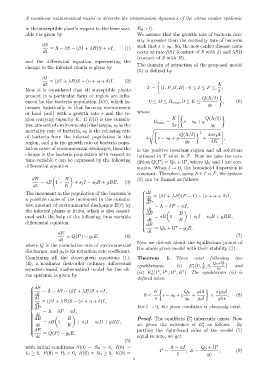
able t is given by We assume that the growth rate of bacteria den-
sity is greater than the mortality rate of bacteria
dS such that s > s 0 . So, the new canker disease cases
= Λ − δS − (βI + λB)S + νI, (1)
dt occur at rate βSI (contact of S with I) and λSB
(contact of S with B).
and the differential equation representing the
The domain of attraction of the proposed model
change in the infected plants is given by
(5) is defined by
dI
= (βI + λB)S − (ν + α + δ)I. (2)
dt Λ
T = (I, P, B, E) : 0 ≤ I ≤ P ≤ ,
Now it is considered that all susceptible plants δ
present in a particular farm or region are influ- Q(Λ/δ)
enced by the bacteria population B(t), which in- 0 ≤ B ≤ B max , 0 ≤ E ≤ , (6)
g 0
creases logistically in that farming environment
or land (soil) with a growth rate s and the re- where
gion carrying capacity K. If E(t) is the cumula- K Q(Λ/δ)
B max = s − s 0 + g
tive amount of environmental discharges, s 0 is the 2s g 0
mortality rate of bacteria, s 1 is the releasing rate s 2
Q(Λ/δ) 4ss 1 Λ
of bacteria from the infected population in the + s − s 0 + g + ,
region, and g is the growth rate of bacteria popu- g 0 δK
lation cause of environmental discharges, then the is the positive invariant region and all solutions
change in the bacteria population with respect to initiated in T exist in T. Now we take the con-
time-variable t can be expressed by the following dition Q(P) = Q 0 + lP, where Q 0 and l are con-
differential equation stants. When l → 0, the household dispersion is
constant. Therefore, using S + I = P, the system
dB B (5) can be framed as follows:
= sB 1 − + s 1 I − s 0 B + gBE. (3)
dt K
The increment in the population of the bacteria is dI
= (βI + λB)(P − I) − (ν + α + δ)I,
a possible cause of the increment in the cumula- dt
tive amount of environmental discharges E(t) by dP = Λ − δP − αI,
the infected plants or fruits, which is also consid- dt
dB B
ered with the help of the following time variable = sB 1 − + s 1 I − s 0 B + gBE,
dt K
differential equation:
dE
= Q 0 + lP − g 0 E.
dE dt
= Q(P) − g 0 E, (4) (7)
dt
Now we discuss about the equilibrium points of
where Q is the cumulative rate of environmental
the above given model with their stability (7).
discharges, and g 0 is its reduction rate coefficient.
Combining all the above-given equations (1)- Theorem 1. There exist following two
(4), a nonlinear first-order ordinary differential equilibriums: (i) E 0, , 0, Q 0 + lΛ and
Λ
∗
δ
equation-based mathematical model for the cit- ∗ ∗ ∗ ∗ ∗ 1 δ g 0
(ii) E (I , P , B , E ). The equilibrium (ii) is
rus epidemic is given by 2
defined when
dS
= Λ − δS − (βI + λB)S + νI, K glΛ s 1 g 0 δ
dt 0 < s − s 0 + g + < . (8)
Q 0
dI s g 0 δ glα
g 0
= (βI + λB)S − (ν + α + δ)I,
dt
dP
For l → 0, the given condition is obviously exist.
= Λ − δP − αI,
dt
∗
dB B Proof. The equilibria E inherently exists. Now
= sB 1 − + s 1 I − s 0 B + gBE,
1
∗
dt K we prove the existence of E 2 as follows. By
dE putting the right-hand sides of the model (7)
= Q(P) − g 0 E,
dt equal to zero, we get
(5)
with initial conditions S(0) = S 0 > 0, I(0) = Λ − αI Q 0 + lP
P = , E = , (9)
I 0 ≥ 0, P(0) = P 0 > 0, B(0) = B 0 ≥ 0, E(0) = δ g 0
3

