Page 11 - IJOCTA-15-1
P. 11

A nonlinear mathematical model to describe the transmission dynamics of the citrus canker epidemic

            From the above-given expression, the constant     The constraints first and second are explicit, and
            quantity and the coefficient of ψ are not positive,  if the third exists, then the fourth also exists as
                                                                                           ∗
            respectively. So by the Routh-Hurwitz criteria,   α 0 > 0. Thus, the equilibria E is locally asymp-
                                                                                           2
            this equilibrium point is unstable.               totically stable under the given constraints.  □
            Now the variational matrix M 2 related to equilib-
                 ∗ ¯ ¯
                          ¯
                             ¯
            ria E (I, P, B, E) is written by
                 2
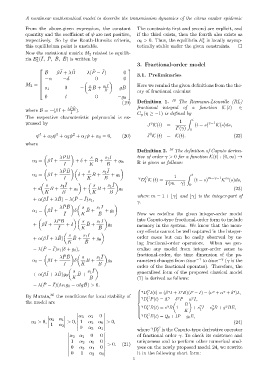
                                                              3. Fractional-order model
                           ¯    ¯        ¯   ¯           
                     B    βI + λB       λ(P − I)        0
                                                              3.1. Preliminaries
                    −α      −d            0            0  
                                                       
            M 2 =                       s ¯   s 1 I ¯       Here we remind the given definitions from the the-
                             0      −    B +         gB
                     s 1                K       ¯
                                                        ¯ 
                                              B             ory of fractional calculus:
                     0        l            0         −g 0
                                                       (19)   Definition 1.  16  The Riemann-Liouville (RL)
                                ¯ ¯
                           ¯
            where B = −(βI +   λPB ).                         fractional  integral  of  a  function  K (t)  ∈
                                I ¯                           C η (η ≥ −1) is defined by
            The respective characteristic polynomial is ex-
                                                                                    Z  t
                                                                                 1
            pressed by                                            J K(t) =              (t − s) γ−1 K(s)ds,
                                                                    γ
                                                                               Γ(γ)  0
                                                                    0
                                 2
                          3
                   4
                 ψ + α 3 ψ + α 2 ψ + α 1 ψ + α 0 = 0,  (20)       J K (t) = K(t).                        (22)
            where
                                                              Definition 2.  16  The definition of Caputo deriva-
                             ¯ ¯
                          λPB          s      s 1 I ¯       tive of order γ > 0 for a function K(t) : (0, ∞) →
                        ¯
                                           ¯
               α 3 =  βI +         + δ +   B +     + g 0 ,
                                                 ¯
                             I ¯         K      B             R is given as follows:
                             ¯ ¯
                          λPB        s      s 1 I ¯
                                          ¯
                        ¯
               α 2 =  βI +          δ +   B +     + g 0                             Z  t
                                                ¯
                             I ¯        K      B              γ D K (t) =     1        (t − s) m−γ−1 K (s)ds,
                                                                                                     m
                                                                 C
                             ¯                  ¯            t        Γ(m − γ)
                     s      s 1 I         s      s 1 I                               0
                                             ¯
                        ¯
                + d    B +      + g 0  +    B +       g 0                                                (23)
                             ¯
                                                  ¯
                     K      B             K       B
                                                              where m = 1 + ⌊γ⌋ and ⌊γ⌋ is the integer-part of
                                  ¯
                                       ¯
                           ¯
                      ¯
                + α(βI + λB) − λ(P − I)s 1 ,
                                                              γ.
                             ¯ ¯
                          λPB     s      s 1 I ¯
                                        ¯
                        ¯
               α 1 =  βI +        δ    B +      + g 0
                                             ¯
                             I ¯     K       B                Now we redefine the given integer-order model
                           ¯ ¯
                        λPB        s     s 1 I ¯          into Caputo-type fractional-order form to include
                                        ¯
                     ¯
                + βI +        + δ      B +       g 0          memory in the system. We know that the mem-
                                             ¯
                           I ¯       K       B
                                                              ory effects cannot be well captured in the integer-
                               s     s 1 I ¯
                                  ¯
                           ¯
                      ¯
                + α(βI + λB)     B +      + g 0               order cases but can be easily observed by us-
                                       ¯
                               K       B                      ing fractional-order operators.  When we gen-
                     ¯
                         ¯
                − λ(P − I)s 1 (δ + g 0 ),                     eralise any model from integer-order sense to
                            ¯ ¯            ¯              fractional-order, the time dimension of the pa-
                           λPB       s      s 1 I
                        ¯
                                        ¯
               α 0 =  βI +        δ    B +       g 0          rameters changes from time −1  to time −γ  (γ is the
                                             ¯
                             I ¯     K       B
                                                              order of the fractional operator). Therefore, the
                                         ¯
                                  s     s 1 I
                      ¯    ¯        ¯                         generalised form of the proposed classical model
                + α(βI + λB)g 0    B +   ¯
                                 K       B                    (7) is derived as follows:
                         ¯
                     ¯
                                       ¯
                − λ(P − I)(δs 1 g 0 − αlgB) > 0.
                                                               γ  C        γ    γ              γ   γ    γ
                                                               D I(t) = (β I + λ B)(P − I) − (ν + α + δ )I,
                                                                  t
            By Murata, 35  the conditions for local stability of    C      γ   γ     γ
                                                              
                                                              γ
                                                               D P(t) = Λ − δ P − α I,
                                                              
            the model are                                         t               B
                                                                                               γ
                                                                                          γ
                                                                γ
                                                                                                     γ
                                                                           γ
                                                                  C
                                                               D B(t) = s B 1 −       + s I − s B + g BE,
                                                                  t
                                                                                   K
                                                                                         1    0
                                                              
                                                              
                                                            
                                                                  C
                                          0                γ D E(t) = Q 0 + lP − g 0 E,
                                    α 3 α 1                       t
                       α 3 α 1
               α 3 > 0,        > 0, 1  α 2 α 0 > 0,                                                    (24)


                       1
                          α 2
                                     0
                                       α 3 α 1                    γ  C
                                                              where D is the Caputo-type derivative operator
                                                                     t
                                α 3 α 1
                                        0    0              of fractional order γ. To check its existence and

                                 1  α 2 α 0  0              uniqueness and to perform other numerical anal-
                                                > 0.  (21)
                                 0            0
                                   α 3 α 1                  yses on the newly proposed model 24, we rewrite

                                 0   1
                                        α 2 α 0             it in the following short form:
                                                            5
   6   7   8   9   10   11   12   13   14   15   16