


Page 15 - IJOCTA-15-1
P. 15
A nonlinear mathematical model to describe the transmission dynamics of the citrus canker epidemic


                                                                           ___γ=1,___γ=0.95,___γ=0.90,___γ=0.85
                        m                                             I(t)
                       X       n                                   400000
                          (−1) (2n + 1)I n = I 0 ,
                       n=0
                                                                   300000
                        m
                       X       n
                          (−1) (2n + 1)P n = P 0 ,
                                                                   200000
                       n=0                             (59)
                        m
                       X       n                                   100000
                          (−1) (2n + 1)B n = B 0 ,
                       n=0                                                                             t
                        m                                                  50   100  150   200  250  300
                       X       n
                          (−1) (2n + 1)E n = E 0 .
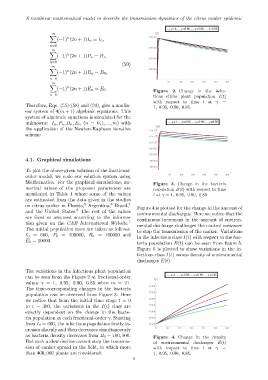
                                                                     Figure   2. Change in the infec-
                       n=0
                                                                     tious citrus plant population I(t)
                                                                     with respect to time t at γ    =
            Therefore, Eqs. (55)-(58) and (59), give a nonlin-       1, 0.95, 0.90, 0.85.
            ear system of 4(m + 1) algebraic equations. This
            system of algebraic equations is simulated for the
            unknowns: I n , P n , B n , E n (n = 0, 1, ..., m) with        ___γ=1,___γ=0.95,___γ=0.90,___γ=0.85
                                                                      B(t)
            the application of the Newton-Raphson iterative        1.4 × 10 6
            scheme.                                                1.2 × 10 6
                                                                   1.0 × 10 6
                                                                   800000
                                                                   600000
            4.1. Graphical simulations                             400000
                                                                   200000
            To plot the above-given solution of the fractional-                                        t
            order model, we code our solution system using                  50   100  150  200  250  300
            Mathematica. For the graphical simulations, nu-          Figure 3. Change in the bacteria
            merical values of the proposed parameters are            population B(t) with respect to time
            mentioned in Table 1 where some of the values            t at γ = 1, 0.95, 0.90, 0.85.
            are estimated from the data given in the studies
                                      5
                                                  6
            on citrus canker in Florida, Argentina, Brazil, 7  Figure 4 is plotted for the change in the amount of
                                   8
            and the United States. The rest of the values     environmental discharges. Here we notice that the
            are fixed or assumed according to the informa-    continuous increment in the amount of environ-
            tion given on the CAB International Website.  1   mental discharge challenges the control measures
            The initial population sizes are taken as follows:  to stop the transmission of the canker. Variations
            I 0 = 600, P 0 = 400000, B 0 = 100000 and
                                                              in the infectious class I(t) with respect to the bac-
            E 0 = 10000.
                                                              teria population B(t) can be seen from figure 5.
                                                              Figure 6 is plotted to show variations in the in-
                                                              fectious class I(t) versus density of environmental
                                                              discharges E(t).
            The variations in the infectious plant population
                                                                           ___γ=1,___γ=0.95,___γ=0.90,___γ=0.85
            can be seen from the Figure 2 at fractional-order
                                                                     E(t)
            values γ = 1, 0.95, 0.90, 0.85 when m = 21.
                                                                   13000
            The time-corresponding changes in the bacteria
                                                                   12500
            population can be observed from Figure 3. Here
            we notice that from the initial time stage t = 0       12000
            to t = 300, the variations in the I(t) class are       11500
            exactly dependent on the change in the bacte-          11000
            ria population at each fractional-order γ. Starting    10500
            from I 0 = 600, the infectious population firstly in-  10000
                                                                                                       t
            creases sharply and then decreases simultaneously         0    50   100  150  200   250  300
            as bacteria density decreases from B 0 = 100, 000.
                                                                     Figure 4. Change in the density
            But such a slow decline cannot stop the transmis-        of environmental discharges E(t)
            sion of canker spread in the field, in which more        with respect to time t at γ    =
            than 400, 000 plants are considered.                     1, 0.95, 0.90, 0.85.
                                                            9

