


Page 13 - IJOCTA-15-1
P. 13
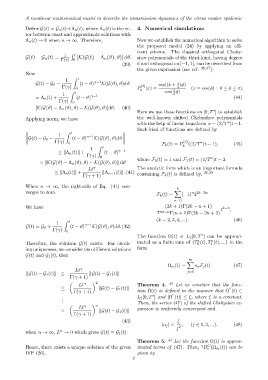
A nonlinear mathematical model to describe the transmission dynamics of the citrus canker epidemic
Define G(t) = G n (t)+Λ n (t), where Λ n (t) is the er- 4. Numerical simulations
ror between exact and approximate solutions with
Λ n (t) → 0 when n → ∞. Therefore, Now we establish the numerical algorithm to solve
the proposed model (24) by applying an effi-
cient scheme. The classical orthogonal Cheby-
R
G(t) − G n (t) = 1 t [K(G(t) − Λ n (ϑ), ϑ)] dϑ. shev polynomials of the third-kind, having degree
Γ(γ) 0
(39) k and orthogonal on [−1, 1], can be described from
the given expression (see ref. 36,37 ):
Now
1 Z t
G(t) − G 0 − (t − ϑ) γ−1 K(G(ϑ), ϑ)dϑ cos((k + )ϕ)
1
Γ(γ) 0 P k (3) (x) = 1 2 (x = cos(ϕ) : 0 ≤ ϕ ≤ π).
1 Z t cos( ϕ)
2
= Λ n (t) + (t − ϑ) γ−1 (44)
Γ(γ) 0
[K(G(ϑ) − Λ n (ϑ), ϑ) − K(G(ϑ), ϑ)]dϑ. (40)
∗
Here we use these functions on [0, T ] to establish
Applying norm, we have the well-known shifted Chebyshev polynomials
∗
with the help of linear transform x = (2/T )t−1.
Such kind of functions are defined by
Z t
1
γ−1
G(t) − G 0 −
(t − ϑ) K(G(ϑ), ϑ)dϑ
∗
Γ(γ) 0
F k (t) = P (3) ((2/T )t − 1), (45)
1 Z t k
≤ ∥Λ n (t)∥ + (t − ϑ) γ−1
Γ(γ) 0
∗
where F 0 (t) = 1 and F 1 (t) = (4/T )t − 3.
× ∥K(G(ϑ) − Λ n (ϑ), ϑ) − K(G(ϑ), ϑ)∥ dϑ
Lt γ The analytic form which is an important formula
≤ ∥Λ n (t)∥ + ∥Λ n−1 (t)∥ .(41) containing F k (t) is defined by, 38,39
Γ(γ + 1)
When n → ∞, the right-side of Eq. (41) con-
k
verges to zero. X n 2k−2n
F k (t) = (−1) 2
n=0
We have (2k + 1)Γ(2k − n + 1) t k−n ,
T ∗k−n Γ(n + 1)Γ(2k − 2n + 2)
(k = 2, 3, 4, ...). (46)
Z t
1 γ−1
G(t) = G 0 + (t − ϑ) K(G(ϑ), ϑ)dϑ.(42)
Γ(γ) 0
∗
The function Ω(t) ∈ L 2 [0, T ] can be approxi-
∗
∗
Therefore, the solution G(t) exists. For check- mated as a finite sum of {T (t), T (t), ...} in the
1
0
ing uniqueness, we consider two different solutions form
G(t) and G 1 (t), then
m
X
Ω m (t) = a j F j (t). (47)
Lt γ j=0
∥G(t) − G 1 (t)∥ ≤ ∥G(t) − G 1 (t)∥
Γ(γ + 1)
Lt Theorem 4. Let us consider that the func-
γ 2 40
≤ ∥G(t) − G 1 (t)∥ ′′
Γ(γ + 1) tion Ω(t) is defined in the manner that Ω (t) ∈
′′
∗
. L 2 [0, T ] and |Ω (t)| ≤ ξ, where ξ is a constant.
.
. Then, the series (47) of the shifted Chebyshev ex-
γ n
Lt pansion is uniformly convergent and
≤ ∥G(t) − G 1 (t)∥
Γ(γ + 1)
(43) ξ
|a j | < , (j ∈ 1, 2, ...). (48)
j 2
n
when n → ∞, L → 0 which gives G(t) = G 1 (t).
Theorem 5. 41 Let the function Ω(t) is approx-
γ
C
Hence, there exists a unique solution of the given imated terms of (47). Then, D (Ω m (t)) can be
t
IVP (26). given by
7

