


Page 16 - IJOCTA-15-1
P. 16
P. Kumar / IJOCTA, Vol.15, No.1, pp.1-13 (2025)

                                      Table 1. Numerical values of the model parameters

                                Parameters Description                          Values
                                Λ           requirement rate of citrus plants   2
                                δ           natural death rate of citrus plants  0.0006
                                β           disease transmission rate from infected plants 0.00000035
                                λ           disease transmission rate from bacteria  0.00000035
                                α           plants death rate cause of canker   0.0008
                                ν           recovery rate                       0.015
                                s           growth rate of bacteria             1
                                K           carrying capacity                   500000
                                s 1         releasing rate of bacteria          8
                                s 0         death rate of bacteria              0.60
                                g           growth rate of bacteria due to discharges  0.000003
                                Q 0         constant                            20
                                l           constant                            0.000006
                                g 0         reduction rate coefficient          0.001

                         ___γ=1,___γ=0.95,___γ=0.90,___γ=0.85  and the population of citrus trees are the major
                     B(t)                                     factors that challenge the impact of control mea-
                                                              sures. Overall, from the given graphical simula-
                 1.2 × 10 6
                                                              tions at various fractional order values γ, we can
                 1.0 × 10 6
                                                              say that the proposed fractional-order mathemat-
                  800000
                                                              ical model worked well to define the transmission
                  600000
                                                              dynamics of the citrus canker for a particular re-
                  400000
                                                              gion. In terms of the Caputo fractional derivative,
                  200000
                                                              the outputs of the model contain memory effects,
                                                     I(t)
                            100000  200000  300000            which is significant while predicting the outbreaks
                                                              of an epidemic.
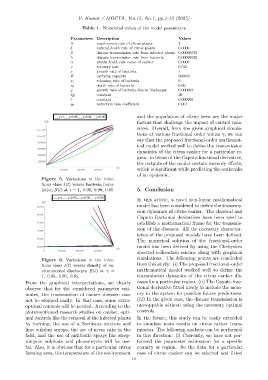
                    Figure 5. Variations in the infec-
                    tious class I(t) versus bacteria popu-
                    lation B(t) at γ = 1, 0.95, 0.90, 0.85.   5. Conclusion
                         ___γ=1,___γ=0.95,___γ=0.90,___γ=0.85
                    E(t)                                      In this article, a novel non-linear mathematical
                 12500                                        model has been considered to define the transmis-
                                                              sion dynamics of citrus canker. The classical and
                 12000
                                                              Caputo fractional derivatives have been used to
                 11500                                        establish a mathematical frame for the transmis-
                                                              sion of the diseases. All the necessary character-
                 11000
                                                              istics of the proposed models have been defined.
                 10500
                                                              The numerical solution of the fractional-order
                 10000                                        model has been derived by using the Chebyshev
                                                     I(t)
                    0      100000  200000  300000
                                                              spectral collocation scheme along with graphical
                                                              simulations. The following points are concluded
                    Figure 6. Variations in the infec-
                    tious class I(t) versus density of en-    from this study: (i) The proposed fractional-order
                    vironmental discharges E(t) at γ =        mathematical model worked well to define the
                    1, 0.95, 0.90, 0.85.                      transmission dynamics of the citrus canker dis-
            From the graphical interpretations, we clearly    eases for a particular region. (ii) The Caputo frac-
            observe that for the considered parameter esti-   tional derivative fitted nicely to include the mem-
            mates, the transmission of canker diseases can-   ory in the system for possible future predictions.
            not be stopped easily. In that case, some extra-  (iii) In the given case, the disease transmission is
            optimal controls will be needed. According to the  unstoppable without using the necessary optimal
            aforementioned research studies on canker, opti-  controls.
            mal controls like the removal of the infected plants  In the future, this study can be easily extended
            by burning, the use of a Bordeaux mixture and     to simulate more results on citrus canker trans-
            lime sulphur sprays, the use of neem cake in the  mission. The following analysis can be performed
            field, and the use of antibiotic sprays like strep-  in this direction: (i) Currently, we have not per-
            tomycin sulphate and phonomycin will be use-      formed the parameter estimation for a specific
            ful. Also, it is obvious that for a particular citrus  country or region. So the data for a particular
            farming area, the temperature of the environment  case of citrus canker can be selected and fitted
                                                            10

