


Page 10 - IJOCTA-15-2
P. 10
Artificial intelligence-assisted station keeping for improved drillship operations
            the vessel’s dynamics. The accelerometers mea-    m-long monohull vessel, specifically designed for
            sure the vessel’s acceleration, which is used to  deepwater environments. To ensure precision dur-
            calculate its velocity and displacement, thereby  ing operations, the drillship is equipped with an
            determining the vessel’s change in position. The  advanced Dynamic Positioning System (DPS),
            AI-controlled system operates by processing real-  enabling it to maintain position and orientation.
            time data from these onboard sensors, mainly the  One of the notable structural features is its rect-
            information from the INS. Based on this data,     angular moonpool. It passes through the hull for
            the AI algorithm predicts the required thruster   equipment such as drilling risers and blowout pre-
            force to counteract external disturbances caused  venters. The moonpool in this vessel has cross-
            by environmental forces such as waves, wind, and  sectional dimensions of 24.8 m × 12.8 m and in-
                                                                        ◦
            currents. Once the required force is determined,  cludes a 90 cutout angle, enhancing its efficiency
            the system activates specific thrusters to gen-   in facilitating drilling operations while minimizing
            erate the calculated force and return the vessel  hydrodynamic resistance. The key geometric and
            to its intended position. This integration of AI  hydrodynamic parameters are detailed in Table
            with the INS creates a sophisticated real-time    1. These parameters provide critical insights into
            control mechanism. The system dynamically ad-     the drillship’s structural design and operational
            justs the thrust forces applied by the thrusters,  characteristics, forming the basis for the study’s
            ensuring the vessel stays within its permissi-    subsequent numerical simulations and analyses.
            ble position limits and achieves precise station-
                                                                  The numerical model of the drillship was
            keeping. The combined use of real-time sensor
                                                              developed based on key characteristics outlined
            data and AI-powered control allows the system        14
                                                              by.  This model was validated for accuracy, en-
            to respond quickly and effectively to external dis-
                                                              suring its reliability for advanced analysis. The
            turbances, significantly improving the accuracy,
                                                              problem was solved numerically using the AN-
            reliability, and operational performance of the
                                                              SYS Explicit Dynamics solver, with the resulting
            drillship’s station-keeping capabilities. This ad-
                                                              simulation data used to generate a database that
            vanced methodology (Figure 2) ensures that the
                                                              supports the development of the AI controller’s
            vessel remains stable and functional, even in chal-
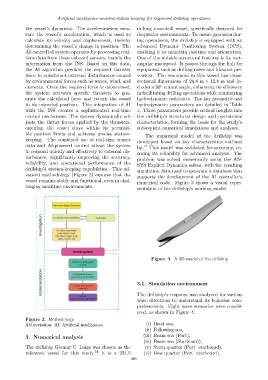
                                                              numerical code. Figure 3 shows a visual repre-
            lenging maritime environments.
                                                              sentation of the drillship’s working model.


                                                                    Figure 3. A 3D model of the drillship


                                                              3.1. Simulation environment

                                                              The drillship’s response was analyzed for various
                                                              wave directions to understand its behavior com-
                                                              prehensively. Eight wave scenarios were consid-
                                                              ered, as shown in Figure 4:
            Figure 2. Methodology
            Abbreviation: AI: Artificial intelligence             (i) Head sea,
                                                                 (ii) Following sea,
            3. Numerical analysis                                (iii) Beam sea (Port),
                                                                 (iv) Beam sea (Starboard),
            The drillship Glomar C. Luigs was chosen as the      (v) Stern quarter (Port starboard),
            reference vessel for this study. 14  It is a 231.5   (vi) Bow quarter (Port starboard).
                                                           205

