


Page 14 - IJOCTA-15-2
P. 14
Artificial intelligence-assisted station keeping for improved drillship operations
            Table 3. Hydrostatic properties

              Parameter                                                       Symbol Magnitude Units
              Longitudinal CoG                                                  LCG         105         m
              Transverse CoG                                                    TCG          0          m
              Vertical CoG                                                      VCG         3.63        m
              Volume displacement                                                ∇       47037.348     m 3
              Longitudinal CoB                                                  LCB        105.81       m
              Transverse CoB                                                    TCB          0          m
              Vertical CoB                                                      VCB        −4.55        m
              Distance between B and G                                          BG         8.182        m
              Transverse metacentric height                                    GM T         2.07        m
              Longitudinal metacentric height                                   GM L      447.178       m
              Transverse metacentric radius                                     BM T       10.253       m
              Longitudinal metacentric radius                                   BM L       447.17       m
              Abbreviations: CoB: Center of buoyancy; CoG: Center of gravity.


            4.3. Response amplitude operators                 ensuring effective station-keeping and optimizing
                                                              operational efficiency of the drillship.
            As previously outlined, the dynamic response of
            the drillship was evaluated under varying wave di-
            rections to gain a comprehensive understanding of
            its behavior. This results section begins by con-
            centrating on the surge in the degree of freedom.
            The surge’s response amplitude operator (RAO)
            was computed for waves approaching the vessel
            from different angles. This computation provides
            crucial insights into the vessel’s longitudinal mo-
            tion (surge), offering a clear picture of its behavior
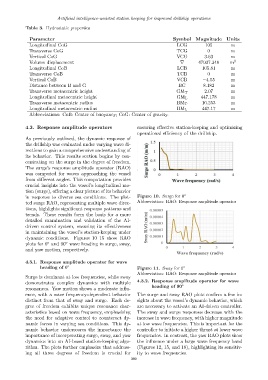
            in response to diverse sea conditions. The plot-  Figure 10. Surge for 0 ◦
            ted surge RAO, representing multiple wave direc-  Abbreviation: RAO: Response amplitude operator
            tions, highlights significant response patterns and
            trends. These results form the basis for a more
            detailed examination and validation of the AI-
            driven control system, ensuring its effectiveness
            in maintaining the vessel’s station-keeping under
            dynamic conditions. Figures 10–15 show RAO
                              ◦
                      ◦
            plots for 0 and 90 wave heading in surge, sway,
            and yaw motion, respectively.
            4.3.1. Response amplitude operator for wave
                   heading of 0 ◦                             Figure 11. Sway for 0 ◦
                                                              Abbreviation: RAO: Response amplitude operator
            Surge is dominant at low frequencies, while sway
                                                              4.3.2. Response amplitude operator for wave
            demonstrates complex dynamics with multiple             heading of 90°
            resonances. Yaw motion shows a moderate influ-
            ence, with a wave frequency-dependent behavior    The surge and sway RAO plots confirm a few in-
            distinct from that of sway and surge. Each de-    sights about the vessel’s dynamic behavior, which
            gree of freedom exhibits unique resonance char-   are necessary to activate an AI-driven controller.
            acteristics based on wave frequency, emphasizing  The sway and surge responses decrease with the
            the need for adaptive control to counteract dy-   increase in wave frequency, with higher magnitude
            namic forces in varying sea conditions. This dy-  at low wave frequencies. This is important for the
            namic behavior underscores the importance the     controller to initiate a higher thrust at lower wave
            importance of incorporating surge, sway, and yaw  frequencies. In contrast, the yaw RAO plots show
            dynamics into an AI-based station-keeping algo-   the influence under a large wave frequency band
            rithm. The plots further emphasize that address-  (Figures 12, 15, and 18), highlighting its sensitiv-
            ing all three degrees of freedom is crucial for   ity to wave frequencies.
                                                           209

