


Page 16 - IJOCTA-15-2
P. 16
Artificial intelligence-assisted station keeping for improved drillship operations
            states. This initial step simulates the vessel’s hy-  or acoustic-based position references. The algo-
            drodynamic behavior in diverse wave and envi-     rithm reduces operational costs and improves re-
            ronmental conditions. The data obtained from      liability by eliminating dependence on external
            these simulations form a comprehensive database   technologies.  Furthermore, the AI algorithm’s
            that captures the vessel’s responses across differ-  ability to dynamically calculate and apply correc-
            ent scenarios. This database is critical as it serves  tive thrust ensures precise station-keeping perfor-
            as the primary reference for the AI algorithm dur-  mance, even under varying sea states and envi-
            ing station-keeping operations. Once the data-    ronmental forces.
            base is compiled, it provides a structured reposi-
            tory of hydrodynamic response data correspond-
            ing to various sea states and wave scenarios. This
                                                              4.5. Algorithm evaluation
            database enables the AI algorithm to reference
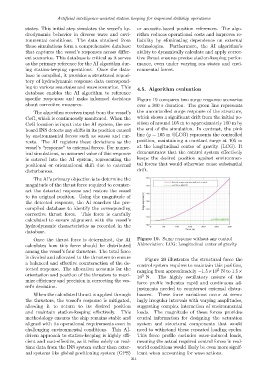
            specific responses and make informed decisions    Figure 19 compares two surge response scenarios
            about corrective measures.                        over a 300 s duration. The green line represents

                The algorithm receives input from the vessel’s  the uncontrolled surge response of the structure,
            CoG, which is continuously monitored. When the    which shows a significant drift from the initial po-
            CoG location is input into the AI system, the on-  sition of around 105 m to approximately 160 m by
            board INS detects any shifts in its position caused  the end of the simulation. In contrast, the pink
            by environmental forces such as waves and cur-    line (y = 105 m @LCG) represents the controlled
            rents. The AI registers these deviations as the   position, maintaining a constant surge at 105 m
            vessel’s “response” to external forces. For numer-  at the longitudinal center of gravity (LCG). It
            ical simulations, an assumed value of this response  demonstrates that the control system effectively
            is entered into the AI system, representing the   keeps the desired position against environmen-
            positional or orientational shift due to external  tal forces that would otherwise cause substantial
            disturbances.                                     drift.
                The AI’s primary objective is to determine the
            magnitude of the thrust force required to counter-
            act the detected response and restore the vessel
            to its original position. Using the magnitude of
            the detected response, the AI searches the pre-
            compiled database to identify the corresponding
            corrective thrust force.  This force is carefully
            calculated to ensure alignment with the vessel’s
            hydrodynamic characteristics as recorded in the
            database.
                Once the thrust force is determined, the AI   Figure 19. Surge response without any control
            calculates how this force should be distributed   Abbreviation: LCG: Longitudinal center of gravity
            among the vessel’s four thrusters. The total force
            is divided and allocated to the thrusters to ensure
                                                                  Figure 20 illustrates the structural force the
            a balanced and effective counteraction of the de-
                                                              control system requires to maintain this position,
            tected response. The allocation accounts for the  ranging from approximately −1.5×10 N to 1.5×
                                                                                                  5
            orientation and position of the thrusters to maxi-  10 N.  The highly oscillatory nature of the
                                                                5
            mize efficiency and precision in correcting the ves-  force profile indicates rapid and continuous ad-
            sel’s deviation.
                                                              justments needed to counteract external distur-
                When the calculated thrust is applied through  bances.  These force variations occur at seem-
            the thrusters, the vessel’s response is mitigated,  ingly irregular intervals with varying amplitudes,
            allowing it to return to its desired position     suggesting complex interaction of environmental
            and maintain station-keeping effectively.  This   loads. The magnitude of these forces provides
            methodology ensures the ship remains stable and   crucial information for designing the actuation
            aligned with its operational requirements even in  system and structural components that would
            challenging environmental conditions. This AI-    need to withstand these repeated loading cycles.
            driven approach to station-keeping is highly effi-  This force profile excludes wave-induced loads,
            cient and cost-effective, as it relies solely on real-  meaning the actual required control forces in real-
            time data from the INS system rather than exter-  world conditions would likely be even more signif-
            nal systems like global positioning system (GPS)  icant when accounting for wave actions.
                                                           211

