


Page 18 - IJOCTA-15-2
P. 18
Artificial intelligence-assisted station keeping for improved drillship operations
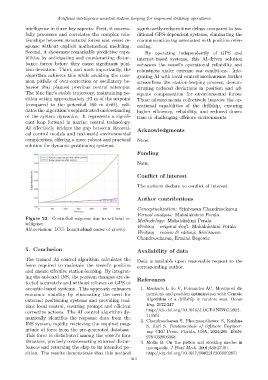
            intelligence in three key aspects: First, it success-  significantly reduces time delays compared to tra-
            fully processes and correlates the complex rela-  ditional GPS-dependent systems, eliminating the
            tionships between structural forces and vessel re-  communication lag associated with position refer-
            sponse without explicit mathematical modeling.    encing.
            Second, it showcases remarkable predictive capa-      By operating independently of GPS and
            bilities by anticipating and counteracting distur-  internet-based systems, this AI-driven solution
            bance forces before they cause significant posi-  enhances the vessel’s operational reliability and
            tion deviation. Third, and most importantly, the  robustness under extreme sea conditions. Inte-
            algorithm achieves this while avoiding the com-   grating AI with local control mechanisms further
            mon pitfalls of over-correction or oscillatory be-  streamlines the station-keeping process, demon-
            havior that plagued previous control attempts.    strating reduced deviations in position and ad-
            The blue line’s stable trajectory, maintaining po-  equate compensation for environmental forces.
            sition within approximately ±3 m of the setpoint  These advancements collectively improve the op-
            (compared to the potential 160 m drift), vali-    erational capabilities of the drillship, ensuring
            dates the algorithm’s sophisticated understanding  higher efficiency, reliability, and reduced down-
            of the system dynamics. It represents a signifi-  time in challenging offshore environments.
            cant leap forward in marine control technology.
            AI effectively bridges the gap between theoreti-  Acknowledgments
            cal control models and real-world environmental
            complexities, offering a more robust and practical  None.
            solution for dynamic positioning systems.
                                                              Funding

                                                              None.

                                                              Conflict of interest

                                                              The authors declare no conflict of interest.

                                                              Author contributions

                                                              Conceptualization: Srinivasan Chandrasekaran
                                                              Formal analysis: Mahalakshmi Perala
            Figure 23. Controlled response due to artificial in-  Methodology: Mahalakshmi Perala
            telligence                                        Writing – original draft: Mahalakshmi Perala
            Abbreviation: LCG: Longitudinal center of gravity
                                                              Writing – review & editing: Srinivasan
                                                              Chandrasekaran, Ermina Begowic

            5. Conclusion                                     Availability of data

            The trained AI control algorithm calculates the   Data is available upon reasonable request to the
            force required to maintain the vessel’s position  corresponding author.
            and ensure effective station-keeping. By integrat-
            ing the onboard INS, the position changes are de-  References
            tected accurately and without reliance on GPS or
            acoustic-based systems. This approach enhances     1. Machado L do V, Fernandes AC. Moonpool di-
            economic viability by eliminating the need for        mensions and position optimization with Genetic
            external positioning systems and providing real-      Algorithm of a drillship in random seas. Ocean
            time local control, ensuring prompt and efficient     Eng. 2022;247.
                                                                  http://dx.doi.org/10.1016/J.OCEANENG.2022.
            corrective actions. The AI control algorithm dy-
                                                                  110561
            namically identifies the response data from the
                                                               2. Chandrasekaran S, Phoemsapthawee S, Krishna
            INS system, rapidly retrieving the required mag-
                                                                  S, Hari S. Fundamentals of Offshore Engineer-
            nitude of force from the pre-generated database.
                                                                  ing. CRC Press, Florida, USA, 2024;280. ISBN:
            This force is distributed among the vessel’s four     9781032806068.
            thrusters, precisely counteracting external distur-  3. Molin B. On the piston and sloshing modes in
            bances and returning the ship to its intended po-     moonpools. J Fluid Mech. 2001;430:27-50.
            sition. The results demonstrate that this method      http://dx.doi.org/10.1017/S0022112000002871
                                                           213

