


Page 13 - IJOCTA-15-2
P. 13
M. Perala, S. Chandrasekaran, E. Begovic / IJOCTA, Vol.15, No.2, pp.202-214 (2025)
                (ii) Based on the database, the AI determines  This distribution pattern is characteristic of ma-
                    the necessary thruster force to counteract  rine structures, where the extremities experience
                    this response and maintain the drillship’s  greater motion amplitudes due to their distance
                    position.                                 from the CoG and reduced structural rigidity.
               (iii) The calculated force is then applied to the  The smooth gradient transition along the ves-
                    thruster, ensuring precise station-keeping  sel’s length indicates a well-distributed motion re-
                    by dynamically adjusting to real-time en-  sponse, with enhanced stability observed in the
                    vironmental conditions.                   midship section.

            4. Results

            The numerical model of the drillship was used to
            perform hydrodynamic diffraction analysis.


            4.1. Hydrostatic properties
            The hydrostatic parameters are summarized in
            Table 3. A positive metacentric height confirms
            the vessel’s stability, indicating that the vessel
                                                                Figure 8. Structural motion amplitude contour
            maintains its upright position and recovers from
            minor disturbances. It is desired to ensure safe
            and stable operations.                            4.2.2. Structural interpolation pressure


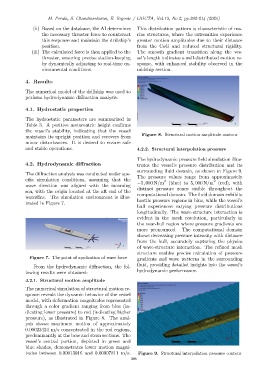
                                                              The hydrodynamic pressure field simulation illus-
            4.2. Hydrodynamic diffraction                     trates the vessel’s pressure distribution and its
                                                              surrounding fluid domain, as shown in Figure 9.
            The diffraction analysis was conducted under spe-
                                                              The pressure values range from approximately
            cific simulation conditions, assuming that the                2                     2
                                                              −5, 000 N/m (blue) to 5, 000 N/m (red), with
            wave direction was aligned with the incoming
                                                              distinct pressure zones visible throughout the
            sea, with the origin located at the aft end of the
                                                              computational domain. The fluid domain exhibits
            waterline. The simulation environment is illus-
                                                              hostile pressure regions in blue, while the vessel’s
            trated in Figure 7.
                                                              hull experiences varying pressure distributions
                                                              longitudinally. The wave-structure interaction is
                                                              evident in the mesh resolution, particularly in
                                                              the near-hull region where pressure gradients are
                                                              more pronounced.    The computational domain
                                                              shows decreasing pressure intensity with distance
                                                              from the hull, accurately capturing the physics
                                                              of wave-structure interaction. The refined mesh
                                                              structure enables precise calculation of pressure
              Figure 7. The point of application of wave force  gradients and wave patterns in the surrounding
                From the hydrodynamic diffraction, the fol-   fluid, providing detailed insights into the vessel’s
            lowing results were obtained:                     hydrodynamic performance.
            4.2.1. Structural motion amplitude
            The numerical simulation of structural motion re-
            sponse reveals the dynamic behavior of the vessel
            model, with deformation magnitudes represented
            through a color gradient ranging from blue (in-
            dicating lower pressure) to red (indicating higher
            pressure), as illustrated in Figure 8. The anal-
            ysis shows maximum motion of approximately
            0.00023424 m/s concentrated in the red regions,
            predominantly at the bow and stern sections. The
            vessel’s central portion, depicted in green and
            blue shades, demonstrates lower motion magni-
            tudes between 0.00013016 and 0.00007811 m/s.      Figure 9. Structural interpolation pressure contour
                                                           208

