


Page 12 - IJOCTA-15-2
P. 12
Artificial intelligence-assisted station keeping for improved drillship operations
                                                              Table 2. Seastates used for simulation

                                                                Wave height (m) Wave period (s)
                                                                0.09                             2
                                                                0.67                            4.8
                                                                1                                4
                                                                1.4                             6.5
                                                                2                                5
                                                                2.44                            8.1
                                                                3                                6
                                                                3.66                            9.7
                                                                5                                9
                                                                5.49                           11.3
                                                                9.14                           13.6
                                                                15.24                           17
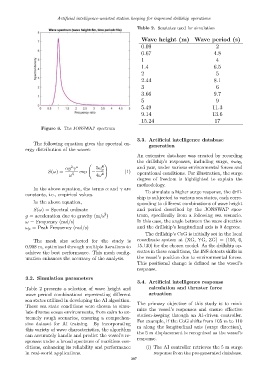
                   Figure 6. The JONSWAP spectrum

                                                              3.3. Artificial intelligence database
                The following equation gives the spectral en-
                                                                   generation
            ergy distribution of the waves:
                                                              An extensive database was created by recording
                                                              the drillship’s responses, including surge, sway,
                                               !
                                 2 a
                              αg γ          5ω 4 p            and yaw, under various environmental forces and
                      S(ω) =        exp −               (1)   operational conditions. For illustration, the surge
                                ω 5         4ω 4
                                                              degree of freedom is highlighted to explain the
                                                              methodology.
                In the above equation, the terms α and γ are
                                                                  To simulate a higher surge response, the drill-
            constants, i.e., empirical values.
                                                              ship is subjected to various sea states, each corre-
                In the above equation,                        sponding to different combinations of wave height
                S(ω) = Spectral ordinate                      and period described by the JONSWAP spec-
                                               2
            g = acceleration due to gravity (m/s )            trum, specifically from a following sea scenario.
            ω = Frequency (rad/s)                             In this case, the angle between the wave direction
            ω p = Peak Frequency (rad/s)                      and the drillship’s longitudinal axis is 0 degrees.
                                                                  The drillship’s CoG is initially set in the local
                The mesh size selected for the study is       coordinate system at (XG, YG, ZG) = (105, 0,
            0.908 m, optimized through multiple iterations to  15.130) for the chosen model. As the drillship op-
            achieve the best performance. This mesh config-   erates in these conditions, the INS detects shifts in
            uration enhances the accuracy of the analysis.    the vessel’s position due to environmental forces.
                                                              This positional change is defined as the vessel’s
                                                              response.
            3.2. Simulation parameters
                                                              3.4. Artificial intelligence response
            Table 2 presents a selection of wave height and        calculation and thruster force
            wave period combinations representing different        actuation
            sea states utilized in developing the AI algorithm.
            These sea state conditions were chosen to simu-   The primary objective of this study is to mini-
            late diverse ocean environments, from calm to ex-  mize the vessel’s responses and ensure effective
            tremely rough scenarios, ensuring a comprehen-    station-keeping through an AI-driven controller.
                                                              For example, if the CoG shifts from 105 m to 110
            sive dataset for AI training. By incorporating
                                                              m along the longitudinal axis (surge direction),
            this variety of wave characteristics, the algorithm
                                                              the 5 m displacement is recognized as the vessel’s
            can accurately handle and predict the vessel’s re-
                                                              response.
            sponses under a broad spectrum of maritime con-
            ditions, enhancing its reliability and performance    (i) The AI controller retrieves the 5 m surge
            in real-world applications.                              response from the pre-generated database.
                                                           207

