


Page 15 - IJOCTA-15-2
P. 15
M. Perala, S. Chandrasekaran, E. Begovic / IJOCTA, Vol.15, No.2, pp.202-214 (2025)


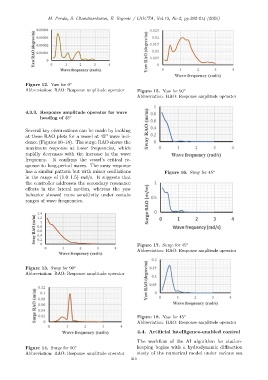
            Figure 12. Yaw for 0 ◦
            Abbreviation: RAO: Response amplitude operator    Figure 15. Yaw for 90 ◦
                                                              Abbreviation: RAO: Response amplitude operator


            4.3.3. Response amplitude operator for wave
                   heading of 45 ◦


            Several key observations can be made by looking
            at these RAO plots for a vessel at 45º wave inci-
            dence (Figures 16–18). The surge RAO shows the
            maximum response at lower frequencies, which
            rapidly decreases with the increase in the wave
            frequency.  It confirms the vessel’s critical re-
            sponse to long-period waves. The sway response
            has a similar pattern but with minor oscillations             Figure 16. Sway for 45 ◦
            in the range of (1.0–1.5) rad/s. It suggests that
            the controller addresses the secondary resonance
            effects in the lateral motion, whereas the yaw
            behavior showed more sensitivity under certain
            ranges of wave frequencies.


                                                              Figure 17. Surge for 45 ◦
                                                              Abbreviation: RAO: Response amplitude operator


            Figure 13. Sway for 90 ◦
            Abbreviation: RAO: Response amplitude operator


                                                              Figure 18. Yaw for 45 ◦
                                                              Abbreviation: RAO: Response amplitude operator
                                                              4.4. Artificial intelligence-enabled control

                                                              The workflow of the AI algorithm for station-
            Figure 14. Surge for 90 ◦                         keeping begins with a hydrodynamic diffraction
            Abbreviation: RAO: Response amplitude operator    study of the numerical model under various sea
                                                           210

