


Page 161 - IJOCTA-15-2
P. 161
J. Gunasekaran et.al / IJOCTA, Vol.15, No.2, pp.354-367 (2025)
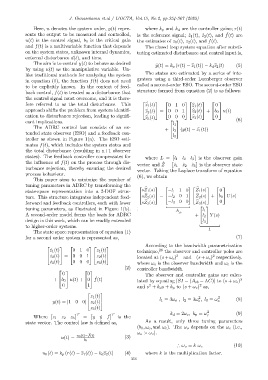
Here, n denotes the system order, y(t) repre- where k p and k d are the controller gains; r(t)
ˆ
sents the output to be measured and controlled, is the reference signal; ˆz 1 (t), ˆz 2 (t), and f(t) are
u(t) is the control signal, b 0 is the critical gain the estimates of z 1 (t), z 2 (t), and f(t).
and f(t) is a multivariable function that depends The closed loop system equation after substi-
on the system states, unknown internal dynamics, tuting estimated disturbance and control input is,
external disturbance d(t), and time.
The aim is to control y(t) to behave as desired
¨ y(t) = k p (r(t) − bz 1 (t)) − k d bz 2 (t) (5)
by using u(t) as the manipulative variable. Un-
The states are estimated by a series of inte-
like traditional methods for analysing the system
grators using a third-order Luenberger observer
in equation (1), the function f(t) does not need
called a second-order ESO. The second-order ESO
to be explicitly known. In the context of feed-
structure formed from equation (2) is as follows:
back control, f(t) is treated as a disturbance that
the control signal must overcome, and it is there-
˙
fore referred to as the total disturbance. This b z 1 (t) 0 1 0 b z 1 (t) 0
approach shifts the problem from system identifi- ˙ b z 2 (t) + b 0 u(t)
b z 2 (t) = 0 0 1
˙
cation to disturbance rejection, leading to signifi- b z 3 (t) 0 0 0 b z 3 (t) 0
cant implications. (6)
l 1
The ADRC control law consists of an ex-
+ l 2 (y(t) − bz 1 (t))
tended state observer (ESO) and a feedback con-
l 3
troller as shown in Figure 1(a). The ESO esti-
mates f(t), which includes the system states and
the total disturbance (resulting in n+1 observer
states). The feedback controller compensates for where L = l 1 l 2 l 3 is the observer gain
the influence of f(t) on the process through dis- ˆ
ˆ
ˆ
vector and Z = ˆz 1 z 2 z 3 is the observer state
turbance rejection, thereby ensuring the desired
vector. Taking the Laplace transform of equation
process behaviour. (6), we obtain
This paper aims to minimize the number of
tuning parameters in ADRC by transforming the
state-space representation into a 2-DOF struc-
ture. This structure integrates independent feed-
forward and feedback controllers, each with fewer
tuning parameters, as illustrated in Figure 1(b).
A second-order model forms the basis for ADRC
design in this work, which can be readily extended
to higher-order systems.
The state space representation of equation (1)
for a second order system is represented as, (7)
According to the bandwidth parametrization
˙ z 1 (t) 0 1 0 z 1 (t) technique, 28 the observer and controller poles are
˙ z 2 (t) = 0 0 1 z 2 (t) 3 2
located at (s + ω o ) and (s + ω c ) respectively.
˙ z 3 (t) 0 0 0 z 3 (t) where ω o is the observer bandwidth and ω c is the
(2) controller bandwidth.
0 0 The observer and controller gains are calcu-
˙
+ b 0 u(t) + 0 f(t) lated by equating |SI − (A ob − LC)| to (s + ω o ) 3
0 1 and s + k d s + k p to (s + ω c ) as,
2
2
z 1 (t) 2 3
o
y(t) = [1 0 0] z 2 (t) l 1 = 3ω o , l 2 = 3ω , l 3 = ω o (8)
z 3 (t)
c
T T k d = 2ω c , k p = ω 2 (9)
˙
Where z 1 z 2 z 3 = y y f is the
state vector. The control law is defined as, As a result, only three tuning parameters
(b 0 , ω o , and ω c ). The ω o depends on the ω c (i.e.,
ω o > ω c ).
u 0 (t)−f(t)
b
u(t) = (3)
b 0
∴ ω o = k ω c (10)
u 0 (t) = k p (r(t) − bz 1 (t)) − k d bz 2 (t) (4) where k is the multiplication factor.
356

