


Page 163 - IJOCTA-15-2
P. 163
J. Gunasekaran et.al / IJOCTA, Vol.15, No.2, pp.354-367 (2025)
Using the Inversion formula, tuning of the
4
3
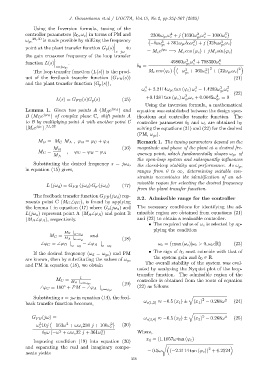
controller parameters (b 0 , ω c ) in terms of PM and 2300ω gc ω + j 1630ω ω − 1000ω 5 c
2
c
gc c
29,30
ω gc is made possible by shifting the frequency 3 2 2
gc
gc
−b 0 ω + 361ω gc b 0 ω c + j 32b 0 ω ω c
to
point at the plant transfer function G p (s) jφ c
s=jω = M c e =⇒ M c cos (φ c ) + jM c sin(φ c )
the gain crossover frequency of the loop transfer
2 4 6
. gc c c
49860ω ω + 798300ω
function L(s) b 0 =
s=jω gc 2 2
2
The loop transfer function (L(s)) is the prod- M c cos (φ c ) −ω + 361ω c 2 + (32ω gc ω c )
gc
uct of the feedback transfer function (G FB (s)) (21)
and the plant transfer function (G p (s)),
3
2
4
ω + 2.2114ω gc tan (φ c ) ω − 1.4289ω ω 2
c
c
gc c
(22)
3
+0.1381 tan (φ c ) ω ω c + 0.0045ω 4 = 0
L(s) = G FB (s)G p (s) (15) gc gc
Using the inversion formula, a mathematical
Lemma 1. Given two points A (M A e jφ A ) and equation was established between the design spec-
B (M B e jφ B ) of complex plane C, shift points A ifications and controller transfer function. The
to B by multiplying point A with another point C controller parameters b 0 and ω c are obtained by
(M c e jφ c ). 31,32 solving the equations (21) and (22) for the desired
(PM, ω gc ).
M B = M C M A , φ B = φ C + φ A Remark 1. The tuning parameters depend on the
(16) magnitude and phase of the plant at a desired fre-
M B
M C = , φ C = φ B − φ A quency point, which fundamentally shapes ω gc of
M A
the open-loop system and subsequently influences
Substituting the desired frequency s = jω d ,
the closed-loop stability and performance. As ω gc
in equation (15) gives, ranges from 0 to ∞, determining suitable con-
straints necessitates the identification of an ad-
missible region for selecting the desired frequency
L (jω d ) = G FB (jω d ) G p (jω d ) (17)
from the plant transfer function.
The feedback transfer function G FB (jω d ) rep-
3.2. Admissible range for the controller
resents point C (M C ∠φ C ), is found by applying
the lemma 1 in equation (17) where G p (jω a ) and The necessary conditions for identifying the ad-
L(jω a ) represent point A (M A ∠φ A ) and point B missible region are obtained from equations (21)
(M B ∠φ B ), respectively. and (22) to obtain a realizable controller.
• The required value of ω c is selected by ap-
plying the condition
M B |
M C = ω=ω d and
M A |
ω=ω d (18)
∠φ C = ∠φ B | − ∠φ A | ω c = {max (ω c )|ω c > 0, ω c ϵR} (23)
ω=ω d ω=ω d
• The sign of b 0 must coincide with that of
If the desired frequency (ω d = ω gc ) and PM
the system gain and b 0 ∈ R.
are known, then by substituting the values of ω gc
and PM in equation (18), we obtain The overall stability of the system was eval-
uated by analyzing the Nyquist plot of the loop-
transfer function. The admissible region of the
M C = 1 controller is obtained from the roots of equation
M A |
ω=ω gc (19)
◦
∠φ C = 180 + PM − ∠φ A | (22) as follows:
ω=ω gc
Substituting s = jω in equation (14), the feed- q 2
ω ≈ −0.5 (x 1 ) ± (x 1 ) − 0.268ω 2 (24)
back transfer function becomes, c(1,2)
q
2
G FB (jω) = ω c(3,4) ≈ −0.5 (x 2 ) ± (x 2 ) − 0.268ω 2 (25)
3
2
−ω 10j −163ω + ωω c 230 j + 100ω c 2 (20)
c
2
2
b 0 ω (−ω + ωω c 32 j + 361ω ) Where,
c
x 1 = (1.1057ω tan (φ c )
Imposing condition (19) into equation (20)
r
and separating the real and imaginary compo- 2
− 0.5ω (−2.2114 tan (φ c )) + 6.2524
nents yields
358

