


Page 166 - IJOCTA-15-2
P. 166
A modified graphical based tuning and performance analysis of second order LADRC . . .
            Table 1. Systems considered for performance and comparative study


                                             Equivalent
              Section    System / Category                                       Transfer function    Reference
                                             Applications
                                             DC motor position control
                         G p1 (Integrating first
              Performance                    (without delay) / Regenerative                              36
                         order plus, delay system)
                 Study                       Heat Exchanger
                                             Magnetic levitation system /
                                                                                      2
                         G p2 (Unstable)     Continuous stirred tank reactor       1/(s − 1)             37
                                             (with delay)
                         G p3 (Second order  Two tank interacting system / Boost
                                                                                        2
                                                                             (
                                                                         (1.6 e − 0.044s))/(s + 1.32s + 27.8)  38
                         underdamped system)  converter
                         G p4 (Second order  Ball beam system / Twin rotor yaw
              Comparative                                                            1/s 2               39
                         integral system)    and pitch control (Quanser)
              Study
                         G p5 (Higher order
                                             Inverted pendulum (with unstable
                         stable system with                                       (1-2s)/(s+1) 3         20
                                             dynamics)
                         RHPZ)
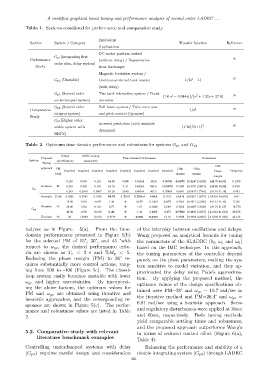
            Table 2. Optimum time domain performance and robustness for systems G p1 and G p2

                            Design   ADRC tuning
                   Proposed                             Time domain Performance            Robustness
              System      specifications  parameters
                    Tuning
                                                                                                 Disk
                   approach  PM                                                 Disk   Gain
                             (rad/sec) (rad/sec) (rad/sec) (rad/sec) (rad/sec) (rad/sec) (rad/sec) (rad/sec)  Phase  Frequency
                         (deg)                                                 margin  margin
                                                                                                margin
                               0.153  0.593  0.121  64.25  9.085  5.915e4  352.6  0.06743  0.8270 [0.4149 2.4102]  [-44.93 44.93]  0.1399
                   Iterative  45  0.201  0.425  0.116  64.32  4.31  9.829e4  585.2  0.05679  0.7044  [0.4791 2.0873]  [-38.80 38.80]  0.3391
               G p1
                               0.249  0.2618  0.0907  81.20  2.683  6.867e4  407.3  0.07805  0.5581  [0.5637 1.7740]  [-31.18 31.18]  0.403
                   Heuristic 32.48  0.2965  0.3242  0.1265  34.78  1.7015  2.233e4  140.8  0.1152  0.5419  [0.6381 1.5672] [-24.916 24.916]  0.41
                               10.08  1.918  4.087  1.49  0   2.675  0.1369  2.675  0.7564  [0.4511 2.2166]  [-41.43 41.43]  7.336
                   Iterative  45  20.06  1.932  8.132  0.77  0  1.01  0.2046  5.599  0.7593  [0.4497 2.2239]  [-41.57 41.57]  14.770
               G p2
                               40.02  1.936  16.216  0.46  0  1.32  0.4068  9.473  0.7600 [0.4493 2.2257] [-41.612 41.612]  29.536
                   Heuristic  45  30  1.9349  12.162  0.5177  0  0.801  0.1027  12.16  0.7598  [0.4494 2.2253] [-41.603 41.603]  22.135
            rad/sec as in Figure.   5(a).   From the time-    of the interplay between oscillations and delays.
            domain performances presented in Figure 5(b)      Wang proposed an analytical formula for tuning
            for the selected PM of 15°, 30°, and 45 °with     the parameters of the SLADRC (b 0 , ω c and ω 0 )
            respect to ω gc , the desired performance crite-  based on the IMC technique. In this approach,
            ria are chosen as T s < 2 s and %M p < 5.         the tuning parameters of the controller depend
            Reducing the phase margin (PM) to 30° re-         purely on the plant parameters, making the sys-
            quires substantially more control actions, rang-
                                                              tem sensitive to model variation, and they ap-
            ing from 100 to -100 (Figure 5c). The closed-
                                                              proximated the delay using Pade’s approxima-
            loop system easily becomes unstable with lower
                                                              tion.  By applying the proposed method, the
            ω gc and higher uncertainties.  By incorporat-
                                                              optimum values of the design specifications ob-
            ing the above factors, the optimum values for
                                                              tained were PM=28° and ω gc = 10.7 rad/sec in
            PM and ω gc are obtained using iterative and
                                                              the iterative method and PM=26.4° and ω gc =
            heuristic approaches, and the corresponding re-
                                                              6.81 rad/sec using a heuristic approach. Servo
            sponses are shown in Figure 5(c). The perfor-
                                                              and regulatory disturbances were applied at 30sec
            mance and robustness values are listed in Table
            2.                                                and 60sec, respectively.  Both tuning methods
                                                              yield comparable settling times and robustness,
                                                              and the proposed approach outperforms Wang’s
            5.2. Comparative study with relevant              in terms of reduced control effort (Figure 6(a),
                 literature benchmark examples
                                                              Table 4).
            Controlling underdamped systems with delay            Balancing the performance and stability of a
            (G p3 ) requires careful design and consideration  double integrating system (G p4 ) through LADRC
                                                           361

