


Page 169 - IJOCTA-15-2
P. 169
J. Gunasekaran et.al / IJOCTA, Vol.15, No.2, pp.354-367 (2025)


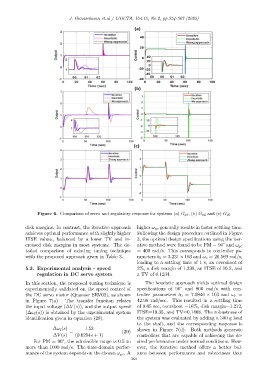
                  Figure 6. Comparison of servo and regulatory response for systems (a) G p3 , (b) G p4 and (c) G p5

            disk margins. In contrast, the iterative approach  higher ω gc generally results in faster settling time.
            achieves optimal performance with slightly higher  Following the design procedure outlined in Figure
            ITSE values, balanced by a lower TV and in-       3, the optimal design specifications using the iter-
            creased disk margins in most systems. The de-     ative method were found to be PM = 90° and ω gc
            tailed comparison of existing tuning technique    = 400 rad/s. This corresponds to controller pa-
            with the proposed approach given in Table 3.      rameters b 0 = 3.231 × 10³ and ω c = 20.569 rad/s,
                                                              leading to a settling time of 1 s, an overshoot of
            5.3. Experimental analysis - speed                2%, a disk margin of 1.339, an ITSE of 16.2, and
                 regulation in DC servo system                a TV of 0.1234.

            In this section, the proposed tuning technique is     The heuristic approach yields optimal design
            experimentally validated on the speed control of  specifications of 90° and 800 rad/s with con-
            the DC servo motor (Quanser SRV02), as shown      troller parameters b 0 = 7.0846 × 10³ and ω c =
            in Figure 7(a).   The transfer function relates   42.98 rad/sec. This resulted in a settling time
            the input voltage (∆V (s)), and the output speed  of 0.65 sec, overshoot =16%, disk margin=1.212,
            (∆ω l (s)) is obtained by the experimental system  ITSE=10.35, and TV=0.1408. The robustness of
            identification given in equation (29).            the system was evaluated by adding a 300 g load
                                                              to the shaft, and the corresponding response is
                         ∆ω l (s)      1.53                   shown in Figure 7(d). Both methods generate
                                =                      (29)
                         ∆V (s)   (0.0254s + 1)               controllers that are capable of achieving the de-
                For PM = 90°, the admissible range is 0.5 to  sired performance under normal conditions. How-
            more than 1000 rad/s. The time-domain perfor-     ever, the iterative method offers a better bal-
            mance of the system depends on the chosen ω gc . A  ance between performance and robustness than
                                                           364

