


Page 167 - IJOCTA-15-2
P. 167
J. Gunasekaran et.al / IJOCTA, Vol.15, No.2, pp.354-367 (2025)
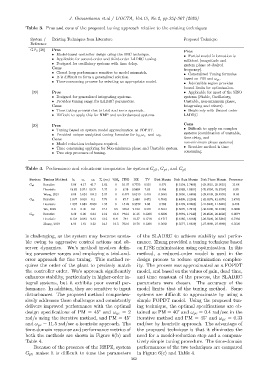
            Table 3. Pros and cons of the proposed tuning approach relative to the existing techniques

               System /  Existing Techniques from Literature                       Proposed Technique
               Reference
               GP 3 [38]  Pros
                                                                                   Pros
                        • Model-based controller design using the IMC technique.
                                                                                   • Partial model information is
                        • Applicable for second-order and third-order LADRC tuning.  sufficient (magnitude and
                        • Designed for oscillatory systems with time delay.        system phase at desired
                        Cons                                                       frequency).
                        • Closed loop performance sensitive to model mismatch.     • Generalized Tuning formulae
                        • It is difficult to form a generalized solution.
                                                                                   based on PM and ω pc .
                        • Time-consuming process for selecting an appropriate model.
                                                                                   • Admissible region provides
                                                                                   bound limits for optimization.
               [39]     Pros                                                       • Applicable for most of the SISO
                        • Designed for generalized integrating systems.            systems (Stable, Oscillatory,
                        • Provides tuning range for LADRC parameters.              Unstable, non-minimum phase,
                        Cons                                                       Integrating and others).
                        • Time taking process due to trial and error approach.     • Deals only with Second order
                        • Difficult to apply this for NMP and underdamped systems.  LADRC.

                                                                                   Cons
               [20]     Pros
                        • Tuning based on system model approximation as FOPDT.     • Difficult to apply on complex
                        • Provided unique analytical tuning formulae for b 0 , ω c and ω 0 .  systems (combination of unstable,
                                                                                   time delay, and
                        Cons
                                                                                   non-minimum phase systems)
                        • Model reduction techniques required.
                        • Time consuming applying for Non-minimum phase and Unstable system.  • Iterative method is time
                        • Two step processes of tuning.                            consuming.


            Table 4. Performance and robustness comparison for systems G p3 , G p4 , and G p5
              System Tuning Method  b 0  ω c  ω 0  T s (sec) %M p ITSE  ISE  TV  Disk Margin Disk Gain Margin Disk Phase Margin Frequency
              G p3  Iterative    3.86  4.17  41.7  2.82  0  10.37 0.7735  0.315  0.579  [0.5134, 1.7403]  [-29.9515, 29.9515]  11.68
                    Heuristic   18.83 5.921 59.21  2.27  0  8.29  0.5894  2.65  0.456  [0.6289, 1.5901]  [-25.6704, 25.6704]  6.99
                    Wang, 2021   6.05  3.624 104.2  2.97  0  8.474 0.6219  3.418  0.5081  [0.5950, 1.6806]  [-28.4939, 28.4939]  14.84
              G p4  Iterative   1.937 0.810  8.1  7.79  0  47.7  2.443  0.472  0.7682  [0.4498, 2.2269]  [-41.6276, 41.6276]  1.4782
                    Heuristic   1.937 4.662 46.62  1.35  0  15.29 0.3572  2.98  0.766  [0.4492, 2.2263]  [-41.6240, 41.6240]  8.499
                    Wu, 2022     0.8  0.35  0.6  17.4  0.5  448.8  9.102  0.318  0.5513  [0.5679, 1.7610]  [-30.8196, 30.8196]  0.6885
                    Iterative    6.39  0.90  9.02  11.9  10.6  774.3  11.15  0.1205  0.5899  [0.7072, 1.7140]  [-29.4620, 29.4620]  0.8577
              G p5
                    Heuristic   8.134 0.942  9.42  12.2  8.41  744  10.57  0.1718  0.4717  [0.6185, 1.6168]  [-26.5246, 26.5246]  0.7493
                    Zhang, 2019  4.93  1.61  3.22  14.5  16.5  762.6  10.76  0.1266  0.5663  [0.5577, 1.6929]  [-27.6989, 27.6989]  0.5526

            is challenging, as the system may become unsta-   of the SLADRC to achieve stability and perfor-
            ble owing to aggressive control actions and ob-   mance. Zhang provided a tuning technique based
            server dynamics.   Wu’s method involves defin-    on ITSE minimization using optimization. In this
            ing parameter ranges and employing a trial-and-   method, a reduced-order model is used in the
            error approach for fine tuning. This method re-   design process to reduce optimization complex-
            quires the order of the plant to precisely match  ity. The process was approximated as a FOPDT
            the controller order. Wu’s approach significantly  model, and based on the values of gain, dead time,
            enhances stability, particularly in higher-order in-  and time constant of the process, the SLADRC
            tegral systems, but it exhibits poor overall per-  parameters were chosen.  The accuracy of the
            formance. In addition, they are sensitive to input  model limits that of the tuning method. Some
            disturbances. The proposed method comprehen-      systems are difficult to approximate by using a
            sively addresses these challenges and consistently  simple FOPDT model. Using the proposed tun-
            delivers improved performance with the optimal    ing technique, the optimal specifications are ob-
            design specifications of PM = 45° and ω gc = 2    tained as PM = 40° and ω gc = 0.4 rad/sec in the
            rad/s using the iterative method, and PM = 45°    iterative method and PM = 45° and ω gc = 0.33
            and ω gc = 11.5 rad/sec a heuristic approach. The  rad/sec by heuristic approach. The advantage of
            time-domain response and performance metrics of   the proposed technique is that it eliminates the
            both the methods are shown in Figure 6(b) and     need for a model-reduction step and a compara-
            Table 4.                                          tively simple tuning procedure. The time-domain
                Because of the presence of the RHPZ, system   performances of the two techniques are compared
            G p5 makes it is difficult to tune the parameters  in Figure 6(c) and Table 4.
                                                           362

