


Page 165 - IJOCTA-15-2
P. 165
J. Gunasekaran et.al / IJOCTA, Vol.15, No.2, pp.354-367 (2025)
                where t sim is the simulation time and e(t) is  with limited search bounds; their efficiency dimin-
            the tracking error.                               ishes as complexity increases. Designing an objec-
                                                              tive function that satisfies all constraints in the
                To ensure reliable performance, the controller  heuristic approach is challenging, as constraints
            must be robust against uncertainties. Disk mar-   can vary significantly across different systems and
            gin is a useful metric for quantifying robustness. 33
                                                              local minima can hinder performance. However,
            It assesses the instability limits based on varia-
                                                              for systems with complex nonlinear dynamics,
            tions in the gain and phase of the loop transfer
                                                              heuristic methods can deliver near-optimal solu-
            function. The disk size and shape were deter-
                                                              tions with a reduced computation time.
            mined based on the maximum tolerable gain and
            phase variations. The disk gain margin indicates  5. Results and discussion
            the allowable range of gain uncertainty for a given
            phase variation. The disk phase margin indicates  The performance and robustness of the proposed
            the allowable range of phase uncertainty for a    tuning method were analyzed using the specific
            given gain variation. In addition, the disk margin  benchmark numerical examples listed in Table 1.
            can help identify the frequency at which the loop  In addition, the effectiveness and applicability of
            transfer function is most susceptible to instability  the proposed method were confirmed through a
                                                              comparison with recent techniques proposed in
            under specific gain and phase variations.
                                                              the literature.
                Two design approaches are employed to de-
            termine the desired PM and ω gc : In the Iterative  5.1. Performance study
            Approach, Parameters are systematically varied    This section comprehensively examines how the
            within specified bounds for PM and ω gc . The     tuning procedure can be applied to design opti-
            resulting performance plot, including both time-  mal controller parameter values for two distinct
            domain and robustness metrics, was analyzed to    systems: integration with time delay (G p1 ) and
            select the optimal design parameters for broad    instability (G p2 ).
            applicability. In the Heuristic Approach, the ad-
                                                                  It is challenging for system G p1 to perform
            missible region, defined by the constraints on the
                                                              satisfactorily for PM > 60° because the increased
            PM and ω gc , is used to guide a heuristic opti-
                                                              phase margin (PM) corresponds to a narrower
            mization technique. In this study, Particle Swarm  admissible region encompassing ω gc , leading to
            Optimization (PSO)  34,35  with ITSE as an objec-
                                                              poor closed-loop system performance. The set-
            tive function was used to efficiently search for the
                                                              tling time and peak overshoot for different com-
            global minimum within this region, yielding the
                                                              binations of PM (45°, 60°, and 75°) with respect
            optimal design parameters. The procedural steps
                                                              to ω gc are plotted in Figure 4(b).
            for both the approaches are detailed in Figure 3.
                                                                  The minimum and maximum value for the fre-
                                                              quency ranges (0.05 and 0.249 rad/s) and the de-
                                                              sired PM were determined based on the peak over-
                                                              shoot and settling time, respectively. This analy-
                                                              sis identified a limited range of PM and ω gc values
                                                              for T s < 50 s and %M p < 10. Within this range,
                                                              based on the control effort required to eliminate
                                                              input and output disturbances, ITSE, TV, and
                                                              robustness, the optimal design specifications are
                                                              chosen as PM = 45° and ω gc = 0.153 rad/s. In the
                                                              heuristic approach, by limiting the bounds for PM
                                                              and ω gc as (30°-75°) and (0.1- 0.33 rad/s), respec-
                                                              tively, the optimum values are found to be PM =
                                                              32.48° and ω gc = 0.2965 rad/sec. Figure 4(c) and
                                                              Table 2 show the corresponding performance and
                                                              robustness.
                                                                  While designing SLADRC for system G p2 ,
                                                              as the Nyquist plot of the plant resides on
                                                              the left side of the real axis, the achiev-
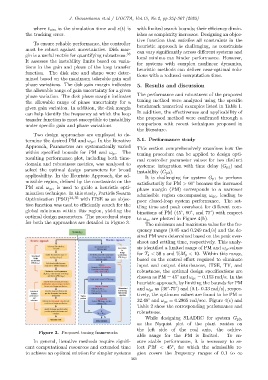
                  Figure 3. Proposed tuning frameworks
                                                              able range for the PM is limited.       To en-
                In general, iterative methods require signifi-  sure stable performance, it is necessary to se-
                                                                             ◦
            cant computational resources and extended time    lect PM < 45 , for which the admissible re-
            to achieve an optimal solution for simpler systems  gion covers the frequency ranges of 0.1 to ∞
                                                           360

