


Page 60 - IJOCTA-15-2
P. 60
Multiple item economic lot sizing problem with inventory dependent demand
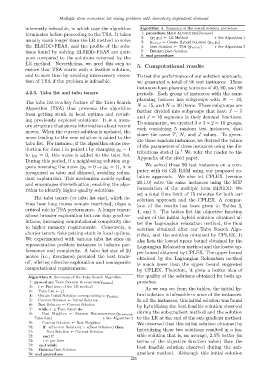
            inherently infeasible, in which case the algorithm  Algorithm 4. Summary of the overall solution procedure.
            terminates before proceeding to the TSA. It takes   1: procedure Main Algorithm(Dataset)
                                                                2:  (y 1 ,y 2 ) ← LR Method     ▷ See Algorithm 1
            usually much longer than the LR method to solve     3:  y initial ← Create Hybrid Solution (y 1 , y 2 )
            the ELSIDD-FEAS, and the profits of the solu-       4:  Best Solution ← TSA (y initial )  ▷ See Algorithm 3
            tions found by solving ELSIDD-FEAS are quite        5:  Return Best Solution
                                                                6: end procedure
            poor compared to the solutions returned by the
            LR method. Nevertheless, we need this step to
                                                              5. Computational results
            ensure that TSA starts with a feasible solution,
            and to save time by avoiding unnecessary execu-   To test the performance of our solution approach,
            tion of TSA if the problem is infeasible.         we generated a total of 90 test instances. These
                                                              instances have planning horizons of 40, 60, and 80
            4.2.3. Tabu list and tabu tenure                  periods. Each group of instances with the same
                                                              planning horizon has subgroups with N = 10,
            The tabu list is a key feature of the Tabu Search
                                                              N = 15, and N = 20 items. These subgroups are
            Algorithm (TSA) that prevents the algorithm
                                                              further divided into subgroups that have J = 5
            from getting stuck in local optima and revisit-
                                                              and J = 10 segments in their demand functions.
            ing previously explored solutions. It is a mem-
                                                              To summarize, we created 3 × 3 × 2 = 18 groups,
            ory structure that stores information about recent
                                                              each containing 5 random test instances, that
            moves. When the current solution is updated, the
                                                              share the same T, N, and J values. To gener-
            move leading to the new solution is added to the
                                                              ate these random instances, we derived the values
            tabu list. For instance, if the algorithm stops pro-
                                                              of the parameters of these instances using the dis-
            duction for item i in period t by changing y it = 1                  4
                                                              tributions stated in. We refer the reader to the
            to y it = 0, this move is added to the tabu list.
                                                              Appendix of the cited paper.
            During this period, if a neighboring solution sug-
                                                                  We solved these 90 test instances on a com-
            gests reversing the move (y it = 0 → y it = 1), it is
                                                              puter with 64 GB RAM using our proposed so-
            recognized as tabu and skipped, avoiding redun-
                                                              lution approach. We also let CPLEX (version
            dant exploration. This mechanism avoids cycling
                                                              20.1.0) solve the same instances using the MIP
            and encourages diversification, enabling the algo-
                                                              formulation of the multiple item ELSIDD. We
            rithm to identify higher-quality solutions.
                                                              set a total time limit of 15 minutes for both our
                The tabu tenure (or tabu list size), which de-
                                                              solution approach and the CPLEX. A compar-
            fines how long moves remain restricted, plays a
                                                              ison of the results has been given in Tables 3,
            critical role in TSA performance. A longer tenure
                                                              4, and 5. The tables list the objective function
            allows broader exploration but can skip good so-  values of the initial hybrid solution obtained af-
            lutions, increasing computational complexity due  ter the Lagrangian relaxation method, the final
            to higher memory requirements. Conversely, a      solution obtained after our Tabu Search Algo-
            shorter tenure risks getting stuck in local optima.  rithm, and the solution obtained by CPLEX. It
            We experimented with various tabu list sizes on
                                                              also lists the lowest upper bound obtained by the
            representative problem instances to balance per-
                                                              Lagrangian Relaxation method and the lowest up-
            formance and complexity. A tabu list size of 20
                                                              per bound obtained by CPLEX. The upper bound
            moves (i.e., iterations) provided the best trade-
                                                              obtained by the Lagrangian Relaxation method
            off, offering effective exploration and manageable
                                                              is much lower than the upper bound suggested
            computational requirements.
                                                              by CPLEX. Therefore, it gives a better idea of
             Algorithm 3. Summary of the Tabu Search Algorithm.  the quality of the solutions obtained for both ap-
              1: procedure Tabu Search Algorithm(y initial )  proaches.
              2:  t ← End time of the LR method                   As we can see from the tables, the initial hy-
              3:  Tabu List ← {}
              4:  Obtain Initial Solution corresponding to y initial  brid solution is infeasible in none of the instances.
              5:  Current Solution ← Initial Solution         In all the instances, this initial solution was found
              6:  Best Solution ← Current Solution            by hybridizing the best feasible solution observed
              7:  while t ≤ Time Limit do
              8:    Best Neighbor ← Search Neighborhood(y current,  during the sub-gradient method and the solution
                Tabu List)                     ▷ See Algorithm 2 to the LR at the end of the sub-gradient method.
              9:    Current Solution ← Best Neighbor          We observed that this initial solution obtained by
             10:    if z(Current Solution) > z(Best Solution) then
             11:      Best Solution ← Current Solution        hybridizing these two solutions resulted in a fea-
             12:    end if                                    sible solution that is, on average, 2.5% better (in
             13:    t ← get time                              terms of the objective function value) than the
             14:  end while                                   best feasible solution observed during the sub-
             15:  Return Best Solution
             16: end procedure                                gradient method. Although this initial solution
                                                           255

