


Page 61 - IJOCTA-15-2
P. 61
¨
                               D. Balpınarlı, M. Onal / IJOCTA, Vol.15, No.2, pp.245-263 (2025)
            is, on average, 14% worse than the solution found     We can see from Table 6 that both CPLEX
            by CPLEX in terms of objective function value, in  and our approach are affected by problem size,
            11 out of 90 instances, it is better than the final  which can be defined by three key factors: T,
            solution of the CPLEX. Noting that it takes at    N and J. Although the gap results of both ap-
            most 15 seconds to execute, these results indicate  proaches increase by problem size, the dominance
            the efficacy of the Lagrangian relaxation method  of our approach on CPLEX is maintained. In or-
            in feeding good initial solutions to the TSA. We  der to determine the effects of these factors on the
            would like to also remark that merely solving     gap values, we performed a 3-factor ANOVA (See
                                                                          84
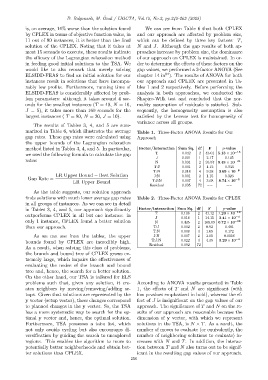
            ELSIDD-FEAS to find an initial solution for our   chapter 14 in ). The results of ANOVA for both
            instances result in solutions that have incompa-  our approach and CPLEX are presented in Ta-
            rably low profits. Furthermore, running time of   bles 1 and 2 respectively. Before performing the
            ELSIDD-FEAS is considerably affected by prob-     analysis in both approaches, we conducted the
            lem parameters: although it takes around 4 sec-   Shapiro-Wilk test and concluded that the nor-
            onds for the smallest instances (T = 40, N = 10,  mality assumption of residuals is satisfied. Sub-
            J = 5), it takes more than 160 seconds for the    sequently, the homogeneity assumption is also
            largest instances ( T = 80, N = 20, J = 10).      satisfied by the Levene test for homogeneity of
                                                              variance across all groups.
                The results of Tables 3, 4, and 5 are sum-
            marized in Table 6, which illustrates the average  Table 1. Three-Factor ANOVA Results for Our
            gap rates. These gap rates were calculated using  Approach
            the upper bounds of the Lagrangian relaxation
            method listed in Tables 3, 4, and 5. In particular,  Factor/Interaction Sum Sq. df  F   p-value
            we used the following formula to calculate the gap        T           0.042  2  43.01 5.13 × 10 −13
                                                                      J           0.001  1   2.17    0.145
            rates:                                                    N           0.091  2  93.57 9.48 × 10 −21
                                                                     T:J          0.001  2   1.12    0.333
                                                                     T:N          0.018  4   9.38  3.69 × 10 −6
                          LR Upper Bound − Best Solution             J:N          0.001  2   1.15    0.323
             Gap Rate =                                                                                   −3
                                 LR Upper Bound                      T:J:N        0.007  4   3.68  8.74 × 10
                                                                   Residual       0.035  72  −−       −−
                As the table suggests, our solution approach
            finds solutions with much lower average gap rates  Table 2. Three-Factor ANOVA Results for CPLEX
            in all groups of instances. As we can see in detail
            in Tables 3, 4, and 5, our approach significantly  Factor/Interaction Sum Sq. df  F     p-value
                                                                      T          0.106   2  41.12  1.23 × 10 −12
            outperforms CPLEX in all but one instance: in                                                 −4
                                                                      J          0.018   1  14.15  3.41 × 10
            only 1 instance, CPLEX found a better solution            N          0.435   2  168.69 6.72 × 10 −28
            than our approach.                                       T:J         0.002   2   0.92    0.401
                                                                     T:N         0.008   4   1.65    0.172
                As we can see from the tables, the upper             J:N         0.007   2   3.01    0.0556  −3
            bounds found by CPLEX are incredibly high.              T:J:N        0.022   4   4.35  3.29 × 10
                                                                   Residual      0.092   72  −−       −−
            As a result, when solving this class of problems,
            the branch and bound tree of CPLEX grows ex-
            tremely large, which impairs the effectiveness of
            evaluating the nodes of the branch and bound
            tree and, hence, the search for a better solution.
            On the other hand, our TSA is tailored for ELS
            problems such that, given any solution, it cre-   According to ANOVA results presented in Table
            ates neighbors by moving/removing/adding se-      1, the effects of T and N are significant (with
            tups. Given that solutions are represented by the  low p-values emphasized in bold), whereas the ef-
            y vector (setup vector), these changes correspond  fect of J is insignificant on the gap values of our
            to planned changes in the y vector. So, the TSA   approach. The significance of T and N on the re-
            has a more systematic way to search for the op-   sults of our approach are reasonable because the
            timal y vector and, hence, the optimal solution.  dimension of y vector, with which we represent
            Furthermore, TSA possesses a tabu list, which     solutions in the TSA, is N × T. As a result, the
            not only avoids cycling but also encourages di-   number of moves to evaluate (or equivalently, the
            versification by guiding the search to unexplored  number of neighboring solutions to evaluate) in-
            regions. This enables the algorithm to move to    creases with N and T. In addition, the interac-
            potentially better neighborhoods and obtain bet-  tion between T and N also turns out to be signif-
            ter solutions than CPLEX.                         icant in the resulting gap values of our approach.
                                                           256

