


Page 64 - IJOCTA-15-2
P. 64
Multiple item economic lot sizing problem with inventory dependent demand
            our analysis, the relative weights of T, N and J in
            predicting the gap results of our approach turned
            out to be 37%, 56% and 6%, respectively, whereas
            corresponding weights for CPLEX turned out to
            be 19%, 72% and 8%, respectively (see Figure 4).
            As the scores suggest, for both CPLEX and our
            approach, the most contributing factor in pre-
            dicting gaps is N; the second contributing factor
            is T; and the least contributing factor is J. For
            our approach, the findings of the FIA agree with  Figure 4. Relative weights of Feature Importance
            the results of ANOVA, which concludes that the    Analysis on the gap values of our approach and
            gap results of our approach are mainly affected   CPLEX
            by T and N, while the effect of J is minimal. The
            findings of FIA agree with the results of ANOVA   6. Conclusion
            for CPLEX gap values. However, we would like
            to remark that a factor might have a low weight
                                                               This study analyzed the multiple-item ELSIDD
            in FIA but might still be statistically significant.  problem, an extension of the ELS problem, where
            This difference may be because the factor has a
                                                              item demands depend on stock quantities. We
            statistically significant, yet small, effect on the  proposed a Tabu Search Algorithm, starting with
            outcome.   For instance, for the gap values of    an initial solution obtained through the La-
            CPLEX, the relative weight of J is low in FIA,    grangian relaxation method.
            whereas the effect of J on gap results is signifi-
            cant, as indicated by ANOVA. See  86,87  for other    We tested the performance of our solution
            example studies who use FIA in the analysis of    procedure on a group of synthetic test instances.
            computational experiments.                        For these instances, we compared the quality of
                                                              the solutions obtained by our algorithm with the
                                                              solutions obtained by CPLEX (a commercial soft-
                                                              ware), which solves the MIP formulations cor-
                                                              responding to these instances. As the test re-
                                                              sults suggest, our solution approach significantly
                                                              outperforms CPLEX. In particular, good solu-
                                                              tions can be found via the Lagrangian relaxation
                                                              method extremely quickly. Then, a Tabu Search
                                                              Algorithm creates much better solutions.

                                                                  While the computational experiments demon-
                                                              strate the effectiveness of the proposed approach,
                                                              we acknowledge its limitations. As the problem
                                                              size increases, the computational effort required
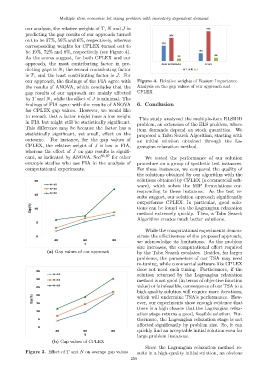
                      (a) Gap values of our approach          by the Tabu Search escalates. Besides, for larger
                                                              problems, the parameters of our TSA may need
                                                              re-tuning, while commercial software like CPLEX
                                                              does not need such tuning. Furthermore, if the
                                                              solution returned by the Lagrangian relaxation
                                                              method is not good (in terms of objective function
                                                              value) or is infeasible, convergence of our TSA to a
                                                              high-quality solution will require more iterations,
                                                              which will undermine TSA’s performance. How-
                                                              ever, our experiments show enough evidence that
                                                              there is a high chance that the Lagrangian relax-
                                                              ation stage returns a good, feasible solution. Fur-
                                                              thermore, the Lagrangian relaxation stage is not
                                                              affected significantly by problem size. So, it can
                                                              quickly find an acceptable initial solution even for
                                                              large problem instances.
                        (b) Gap values of CPLEX
                                                                  Since the Lagrangian relaxation method re-
            Figure 3. Effect of T and N on average gap values  sults in a high-quality initial solution, an obvious
                                                           259

