


Page 159 - IJOCTA-15-3
P. 159
Proportional integral derivative plus control for nonlinear discrete-time state-dependent parameter. . .
                The time-invariant P matrix can be ob-        enables efficient and intuitive control of these sys-
            tained by freezing F k at a specific operating    tems, which are characterized by discrete-time
            point u k−2 = u k−3 = 0. The weights R = 1        TFs of any order and sampling time delays.
            and Q = diag {1 1 1 1 1} were selected to ob-         The selected demonstrators represent the first
            tain the time-invariant P matrix using algebraic  industrial implementations of the SDP-PID+ con-
            Riccatti equation as defined in Equation (29).    trol methodology, showcasing its applicability
            The time-variant SDP-PID+ gain vector, k   +  is  across systems with varying response times, 240
                                                       k
            then computed using Equation (30). The control    and 0.5 s, respectively, providing a comprehensive
            law in Equation (24) is employed to control the   evaluation of their performance.
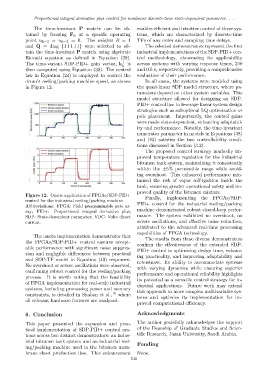
            drum’s reeling/packing machine speed, as shown        In all cases, the systems were modeled using
            in Figure 12.                                     the quasi-linear SDP model structure, where pa-
                                                              rameters depend on other system variables. This
                                                              model structure allowed for designing an SDP-
                                                              PID+ control law to leverage linear system design
                                                              strategies such as suboptimal LQ optimization or
                                                              pole placement. Importantly, the control gains
                                                              were made state-dependent, enhancing adaptabil-
                                                              ity and performance. Notably, the time-invariant
                                                              numerator parameter in models in Equations (38)
                                                              and (43) satisfies the two controllability condi-
                                                              tions discussed in Section (3.2).
                                                                  The proposed control strategy markedly im-
                                                              proved temperature regulation for the industrial
                                                              bitumen tank system, maintaining it consistently
                                                              within the ±5% permissible range while avoid-
                                                              ing overshoot. This enhanced performance min-
                                                              imized the risk of vapor self-ignition inside the
                                                              tank, ensuring greater operational safety and im-
                                                              proved quality of the bitumen mixture.
            Figure 12. Onsite application of FPGAs/SDP-PID+       Finally,  implementing the FPGAs/SDP-
            control for the industrial reeling/packing machine.
                                                              PID+ control for the industrial reeling/packing
            Abbreviations: FPGA: Field programmable gate ar-
            ray; PID+:   Proportional integral derivative plus;  machine demonstrated robust closed-loop perfor-
            SDP: State-dependent parameter; VDC: Volts direct  mance. The system exhibited no overshoot, no
            current.                                          severe oscillations, and effective noise reduction,
                                                              attributed to the advanced real-time processing
                                                              capabilities of FPGA technology.
                The onsite implementation demonstrates that
                                                                  The results from these diverse demonstrators
            the FPGAs/SDP-PID+ control ensures accept-
                                                              confirm the effectiveness of the extended SDP-
            able performance with significant noise suppres-
                                                              PID+ control in optimizing design time, enhanc-
            sion and negligible differences between practical
                                                              ing practicality, and improving adaptability and
            and SDP-TF model in Equation (40) responses.
                                                              robustness. Its ability to accommodate systems
            No overshoot or severe oscillations were observed,
                                                              with varying dynamics while ensuring superior
            confirming robust control for the reeling/packing
                                                              performance and operational reliability highlights
            process. It is worth noting that the feasibility  its potential as a versatile control strategy for in-
            of FPGA implementation for real-scale industrial  dustrial applications. Future work may extend
            systems, including processing power and memory    this approach to more complex multivariable sys-
            constraints, is detailed in Shaban et al., 15  where  tems and optimize its implementation for im-
            all relevant hardware features are analyzed.
                                                              proved computational efficiency.
            6. Conclusion                                     Acknowledgments

            This paper presented the expansion and prac-      The author gratefully acknowledges the support
            tical implementation of SDP-PID+ control sys-     of the Deanship of Graduate Studies and Scien-
            tems across two distinct demonstrators: an indus-  tific Research, Jazan University, Saudi Arabia.
            trial bitumen tank system and an industrial reel-
                                                              Funding
            ing/packing machine used in the bitumen mem-
            brane sheet production line. This enhancement     None.
                                                           531

