Page 155 - IJOCTA-15-3
P. 155

Proportional integral derivative plus control for nonlinear discrete-time state-dependent parameter. . .
            Rockwool blocks insulate the tank’s exterior to
            minimize heat loss and reduce power consump-
            tion.
                A motorized three-way valve and a PT100
            temperature sensor are integrated into this ther-
            mal process and connected to a data acquisition
            unit (LabJack UE9) interfaced with a LabVIEW™
            program. The valve’s opening is normalized from
            0 (fully closed) to 100 (fully open) to regulate the
            flow rate of the hot oil, functioning as an actua-
            tor. The PT100 provides temperature feedback
            for the control system. A LabVIEW™ module
            was developed to manage the hardware compo-
            nents (three-way valve and PT100 sensor) and
            apply the selected controller. Additional hard-
            ware/software interfacing details can be found in
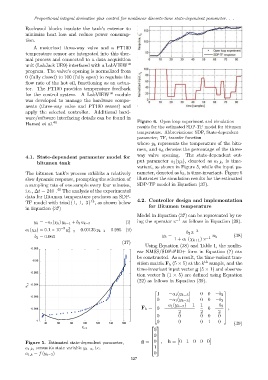
            Hamed et al. 40                                   Figure 6. Open loop experiment and simulation
                                                              results for the estimated SDP-TF model for bitumen
                                                              temperature. Abbreviations: SDP, State-dependent
                                                              parameter; TF, transfer function
                                                              where y k represents the temperature of the bitu-
                                                              men, and u k denotes the percentage of the three-
                                                              way valve opening.   The state-dependent out-
            4.1. State-dependent parameter model for
                                                              put parameter a 1 (χ k ), denoted as a 1,k , is time-
                 bitumen tank
                                                              variant, as shown in Figure 5, while the input pa-
            The bitumen tank’s process exhibits a relatively  rameter, denoted as b 3 , is time-invariant. Figure 6
            slow dynamic response, prompting the selection of  illustrates the simulation results for the estimated
            a sampling rate of one sample every four minutes,  SDP-TF model in Equation (37).
            i.e., ∆t = 240 . 40  The analysis of the experimental
            data for Bitumen temperature produces an SDP-
                                         13
            TF model with triad {1, 1, 3} , as shown below    4.2. Controller design and implementation
                                                                   for Bitumen temperature
            in Equation (37)
                                                              Model in Equation (37) can be represented by us-
                y k = −a 1 (χ k ) y k−1 + b 3 u k−3      (i)  ing the operator z −1  as follows in Equation (38).
            a 1 (χ k ) = 0.1 × 10 −5  y 2 k−3  − 0.00135 y k−3 − 0.995 (ii)         b 3 z −3
                b 3 = 0.063                                              y k =              −1  u k      (38)
                                                                              1 + a 1 (χ k+1 ) z
                                                       (37)
                                                                  Using Equation (38) and Table 1, the nonlin-
                                                              ear NMSS/SDP-PID+ form in Equation (7) can
                                                              be constructed. As a result, the time-variant tran-
                                                              sition matrix F k (5 × 5) at the k th  sample, and the
                                                              time-invariant input vector g (5 × 1) and observa-
                                                              tion vector h (1 × 5) are defined using Equation
                                                              (22) as follows in Equation (39).


                                                                                                    
                                                                       1    −a 1 (y k−3 )  0  0  −b 3
                                                                     0     −a 1 (y k−3 )  0  0  −b 3  
                                                                          −a 1 (y k−3 ) − 1  1
                                                                                                    
                                                                                                −b 3 
                                                                F k = 0                     0        ,
                                                                                2         2
                                                                                                 2 
                                                                       0        0         0  0    0
                                                                                                    
                                                                       0        0         0  1    0      (39)
                                                                     
                                                                     0
                                                                     0
                                                                     
                                                                     
            Figure 5. Estimated state-dependent parameter,      g = 0 ,     h = 0 1 0 0 0
                                                                     
                                                                     
                                                                     1
            a 1,k , versus its state variable y k−3 , i.e.           
            a 1,k = f (y k−3 )                                       0
                                                           527
   150   151   152   153   154   155   156   157   158   159   160