Page 152 - IJOCTA-15-3
P. 152

E.M. Shaban / IJOCTA, Vol.15, No.3, pp.517-534 (2025)
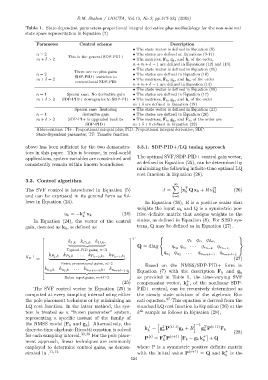
            Table 1. State-dependent parameters-proportional integral derivative plus methodology for the non-minimal
            state space representation in Equation (7)

                 Parameter          Control scheme                           Description
                                                            • The state vector is defined in Equation (8)
                 n ≥ 2                                      • The states are defined at Equations (9-11)
                               This is the general SDP-PID+
                 m + δ > 2                                  • The matrices, F k , g , and h, of the order,
                                                                              k
                                                            n + m + δ − 1 are defined in Equations (12) and (13).
                                                            • The state vector is defined in Equation (15)
                                  There are no plus gains
                 n = 2                                      • The states are defined in Equation (16)
                                  SDP-PID+ switches to
                 m + δ = 2                                  • The matrices, F k , g , and h k , of the order
                                                                              k
                                  conventional SDP-PID
                                                            n + m + δ − 1 are defined in Equation (14)
                                                            • The state vector is defined in Equation (18)
                 n = 1         Special case: No derivative gain  • The states are defined in Equation (17)
                 m + δ > 2   SDP-PID+ downgrades to SDP-PI+ • The matrices, F k , g , and h, of the order
                                                                              k
                                                            m + δ are defined in Equation (19)
                                  Special case: Restoring   • The state vector is defined in Equation (21)
                 n = 1                derivative gain       • The states are defined in Equation (20)
                 m + δ > 2     SDP-PI+ is upgraded back to  • The matrices, F k , g , and F k , of the order are
                                                                              k
                                       SDP-PID+             m + δ + 1 defined in Equation (22)
                 Abbreviations: PI+: Proportional integral plus; PID: Proportional integral derivative; SDP:
                 State-dependent parameter; TF: Transfer function.
            above has been sufficient for the two demonstra-  3.3.1. SDP-PID+/LQ tuning approach
            tors in this paper. This is because, in real-world
                                                              The optimal SVF/SDP-PID+ control gain vector,
            applications, system variables are constrained and
                                                              as defined in Equation (25), can be determined by
            consistently remain within known boundaries.
                                                              minimizing the following infinite-time optimal LQ
                                                              cost function in Equation (26).
            3.3. Control algorithm
                                                                              ∞
                                                                                   T
            The SVF control is introduced in Equation (5)                J =  X  x Q x k + R u 2 k     (26)
                                                                                   k
            and can be expressed in its general form as fol-                  k=0
            lows in Equation (24).                                In Equation (26), R is a positive scalar that
                                                              weights the input u k and Q is a symmetric pos-
                                      +
                              u k = −k x k             (24)   itive definite matrix that assigns weights to the
                                      k
                In Equation (24), the vector of the control   states, as defined in Equation (8). For SISO sys-
            gain, denoted as k k , is defined as              tems, Q may be defined as in Equation (27).


                                                                                                          
                                                          T
                               k I,k k P 1 ,k k D,k ,                              q z q e 1  q ∆e,       
                                                           Q = diag                 · · ·
                               |       {z      }
                                                                            q e 2  q e 3  q e n−2  q e n−1,
                               Typical PID gains, n≤2
                                                                                                        
                                                                                  . . .
                                                                          q u 1  q u 2   q u m+δ−3  q u m+δ−2
               +    k P 2 ,k k P 3 ,k . . . k P n−2 ,k , k P n−1 ,k , 
            K K                                                                                          (27)
                 =   |                {z               } 
                                                         
                            Extra proportional gains, n>2
                                                                Based on the NMSS/SDP-PID+ form in
                     k
                                                         
                                                         k
                    u 1 ,k k u 2 ,k . . . k u m+δ−3 ,k , k u m+δ−2 ,   Equation (7) with the description F k and g
                     |                 {z                }                                                  k
                              Extra input gains, m+δ≥2        as provided in Table 1, the time-varying SVF
                                                                                    +
                                                       (25)   compensator vector, k , of the nonlinear SDP-
                                                                                    k
                The SVF control vector in Equation (25) is    PID+ control, can be recursively determined as
            computed at every sampling interval using either  the steady state solution of the algebraic Ric-
            the pole placement technique or by minimizing an  cati equation. 37  This equation is derived from the
            LQ cost function. In the latter method, the sys-  standard LQ cost function in Equation (26) at the
            tem is treated as a “frozen parameter” system,    k th  sample as follows in Equation (28),
            representing a specific instant of the family of
            the NMSS model [F k and g ]. Alternatively, the            h               i −1
                                       k                           +     T  (i+1)           T  (i+1)
            discrete-time algebraic Riccatti equation is solved  k = g P        g k + R   g P      F k   (28)
                                                                                            k
                                                                         k
                                                                   k
            for each sampling interval. 33,36  For the pole place-  (i)   T  (i+1)        +
                                                                 P    = F P       F k − g k k  + Q
            ment approach, linear techniques are commonly                 k                k
            employed to determine control gains, as demon-    where P is a symmetric positive definite matrix
            strated in . 11,12                                with the initial value P (i+1)  = Q and k +  is the
                                                                                                     k
                                                           524
   147   148   149   150   151   152   153   154   155   156   157