


Page 149 - IJOCTA-15-3
P. 149
Proportional integral derivative plus control for nonlinear discrete-time state-dependent parameter. . .


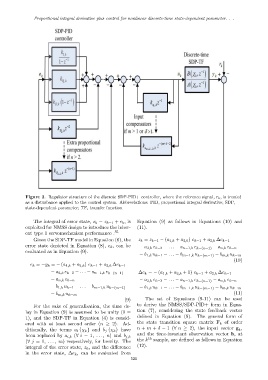
            Figure 2. Regulator structure of the discrete SDP-PID+ controller, where the reference signal, r k , is treated
            as a disturbance applied to the control system. Abbreviations: PID, proportional integral derivative; SDP,
            state-dependent parameter; TF, transfer function


                The integral of error state, z k = z k−1 + e k , is  Equation (9) as follows in Equations (10) and
            exploited for NMSS design to introduce the inher-  (11).
            ent type 1 servomechanism performance . 35
                Given the SDP-TF model in Equation (6), the   z k = z k−1 − (a 1,k + a 2,k ) e k−1 + a 2,k ∆e k−1
            error state depicted in Equation (8), e k , can be  − a 3,k e k−3 − . . . − a n−1,k e k−(n−1)  − a n,k e k−n
            evaluated as in Equation (9).
                                                               − b 1,k u k−1 − . . . − b m−1,k u k−(m−1)  − b m,k u k−m
                                                                                                         (10)
              e k = −y k = − (a 1,k + a 2,k ) e k−1 + a 2,k ∆e k−1
                        − a 3,k e k−3 − . . . − a n−1,k e k−(n−1)  ∆e k = − (a 1,k + a 2,k + 1) e k−1 + a 2,k ∆e k−1
                        − a n,k e k−n                          − a 3,k e k−3 − . . . − a n−1,k e k−(n−1)  − a n,k e k−n
                        − b 1,k u k−1 − . . . − b m−1,k u k−(m−1)  − b 1,k u k−1 − . . . − b m−1,k u k−(m−1)  − b m,k u k−m
                                                                                                         (11)
                        − b m,k u k−m
                                                        (9)       The set of Equations (9-11) can be used
                For the sake of generalization, the time de-  to derive the NMSS/SDP-PID+ form in Equa-
            lay in Equation (9) is assumed to be unity (δ =   tion (7), considering the state feedback vector
            1), and the SDP-TF in Equation (4) is consid-     defined in Equation (8).  The general form of
            ered with at least second order (n ≥ 2). Ad-      the state transition square matrix F k of order
            ditionally, the terms a i {χ k } and b j {χ k } have  n + m + δ − 1 (∀ n ≥ 2), the input vector g ,
                                                                                                           k
                                                              and the time-invariant observation vector h, at
            been replaced by a i,k (∀ i = 1, . . . , n) and b j,k  th
            (∀ j = 1, . . . , m) respectively, for brevity. The  the k  sample, are defined as follows in Equation
            integral of the error state, z k , and the difference  (12).
            in the error state, ∆e k , can be evaluated from
                                                           521

