Page 150 - IJOCTA-15-3
P. 150

E.M. Shaban / IJOCTA, Vol.15, No.3, pp.517-534 (2025)

                           "                                                  #
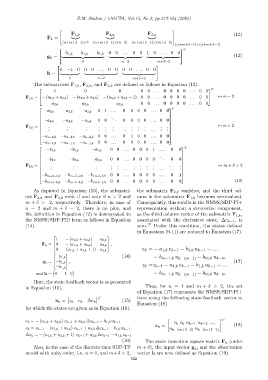
                                 F 1,k          F 2,k              F 3,k                                 (13)
                      F k =      |{z}           |{z}               |{z}
                             (n+m+δ−1)×3  (n+m+δ−1)×(n−2)   (n+m+δ−1)×(m+δ−2)
                                                                               (n+m+δ−1)×(n+m+δ−1)
                           "                                                     # T
                            −b 1,k −b 1,k −b 1,k 0 0 . . . 0 0 1 0 . . . 0 0
                                                                                                         (12)
                      g k = |        {z       } |       {z     } |       {z     }
                                     3                 n−2             m+δ−2
                          "                                           #
                            0 −1 0 0 0 . . . 0 0 0 0 . . . 0 0
                      h = |    {z   } |      {z     } |       {z     }
                                3           n−2             m+δ−2
                The submatrices F 1,k , F 2,k , and F 3,k are defined as follows in Equation (13).


                As depicted in Equation (13), the submatri-   the submatrix F 2,k vanishes, and the third col-
            ces F 2,k and F 3,k exist if and only if n > 2 and  umn in the submatrix F 1,k becomes zero-valued.
            m + δ > 2, respectively. Therefore, in case of    Consequently, this results in the NMSS/SDP-PI+
            n = 2 and m + δ = 2, there is no plus, and        representation without a derivative component,
            the definition in Equation (12) is downgraded to  as the third column vector of the submatrix F 1,k ,
            the NMSS/SDP-PID form as follows in Equation      associated with the derivative state, ∆e k−1 , is
            (14).                                             zero. 17  Under this condition, the states defined
                                                              in Equations (9-11) are reduced to Equation (17).
                                                
                          1   − (a 1,k + a 2,k )  a 2,k
                    F k = 0   − (a 1,k + a 2,k )  a 2,k ,
                         
                                                 
                                                                e k = − a 1,k e k−1 − b 1,k u k−1 − . . .
                          0 − (a 1,k + a 2,k + 1) a 2,k
                             
                          −b 1,k                       (14)          − b m−1,k u k−(m−1)  − b m,k u k−m
                    g k = −b 1,k ,                                                                       (17)
                              
                         
                                                                z k =z k−1 − a 1,k e k−1 − b 1,k u k−1 − . . .
                          −b 1,k
                                                                   − b m−1,k u
                 and h = 0 −1 0                                                 k−(m−1)  − b m,k u k−m
                Here, the state feedback vector is as presented
            in Equation (15),                                     Thus, for n = 1 and m + δ > 2, the set
                                                              of Equation (17) represents the NMSS/SDP-PI+
                                             T
                                                            form using the following state feedback vector in
                          x k = z k e k ∆e k           (15)
                                                              Equation (18).
            for which the states are given as in Equation (16).
                                                                                                  T
            e k = − (a 1,k + a 2,k ) e k−1 + a 2,k ∆e k−1 − b 1,k u k−1       z k e k u k−1 u k−2 ...,
                                                                      x k =                              (18)
            z k = z k−1 − (a 1,k + a 2,k ) e k−1 + a 2,k ∆e k−1 − b 1,k u k−1  u k−(m+δ−3)  u k−(m+δ−2)
            ∆e k = − (a 1,k + a 2,k + 1) e k−1 + a 2,k ∆e k−1 − b 1,k u k−1
                                                       (16)       The state transition square matrix F k (order
                Also, in the case of the discrete-time SDP-TF  m + δ), the input vector g , and the observation
                                                                                       k
            model with unity order, i.e. n = 1, and m+δ > 2,  vector h are now defined as Equation (19).
                                                           522
   145   146   147   148   149   150   151   152   153   154   155