


Page 153 - IJOCTA-15-3
P. 153
Proportional integral derivative plus control for nonlinear discrete-time state-dependent parameter. . .
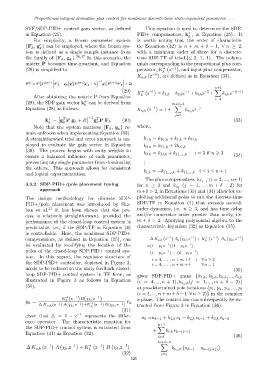
            SVF/SDP-PID+ control gain vector, as defined          This equation is used to determine the SDP-
                                                                                     +
            in Equation (25).                                 PID+ compensators, k , in Equation (25). It
                                                                                     k
                For simplicity, a frozen parameter system     is worth noting that the order of characteris-
               ′
                   ′
            {F , g } can be employed, where the frozen sys-   tic Equation (32) is n + m + δ − 1, ∀ n ≥ 2,
                   k
               k
            tem is defined as a single sample instance from   with a minimum order of three for a discrete-
            the family of {F k , g }. 36,37  In this scenario, the  time SDP-TF of triad {≤ 2, 1, 1}. The polyno-
                                k
            matrix P becomes time-invariant, and Equation     mials corresponding to the proportional plus com-
            (28) is simplified to                             pensator, K +  z −1   , and input plus compensator,
                                                                         k

                                                              K u,k z −1  , are defined as in Equation (33),

                                            −1
                                 ′ T
                  ′ T
                                               ′ T
                                                      ′
                          ′
            P (i)  = F k P (i+1)  F k − g k g k P (i+1) ′  g k P (i+1) F k + Q
                                       g k + R
                                                                                                n+1
                                                       (29)     +  −1             −1       −2  X       −(i−1)
                                                              K k  z   = k 1,k − k 2,k z  + k 3,k z  +  k i,k z
                After obtaining the matrix P from Equation                                       i=4
                                      +
            (29), the SDP gain vector k can be derived from
                                      k                                      m+δ−2
                                                                               X
            Equation (28) as follows:                         K u,k z −1  = 1 +    k u j ,k z −j

                                                                               j=1
                                        −1

                             T
                                            T
                       +

                     k = g P g k + R       g P F k     (30)                                              (33)
                       k     k              k
                Note that the system matrices {F k , g } re-  where,
                                                     k
            main unfrozen when implementing Equation (30).
            A straightforward trial and error approach is em-    k 1.k = k P 1 ,k + k I,k + k D,k
            ployed to evaluate the gain vector in Equation       k 2.k = k P 1 ,k + 2k D,k
            (30). The process begins with unity weights to
                                                                 k 3.k = k D,k + k P i−1 ,k  i = 3 if n ≥ 3
            ensure a balanced influence of each parameter,                                               (34)
            preventing any single parameter from dominating      . . .
            the others. This approach allows for consistent      k i,k = −k P i−2 ,k + k P i−1 ,k 4 ≤ i ≤ n + 1
            and logical experimentation.
                                                                                              (i = 3, ..., n+1)
                                                                  The plus compensators, k P i−1
            3.3.2. SDP-PID+/pole placement tuning                                 (j = 1, . . . m + δ − 2) for
                                                              for n ≥ 3 and k u j
                   approach                                   m+δ > 2, in Equations (33) and (34) allow for ex-
            The design methodology for discrete SDP-          ploiting additional poles to suit the discrete-time
            PID+/pole placement was introduced by Sha-        SDP-TF in Equation (4) that exceeds second-
            ban et al. 11  It has been shown that the pro-    order dynamics, i.e. n ≥ 3, and has time delay
            cess is relatively straightforward, provided the  and/or numerator order greater than unity, i.e.
            performance of the closed-loop control system is  m + δ > 2. Applying polynomial algebra to the
            predictable, i.e., if the SDP-TF in Equation (4)  characteristic Equation (32) as Equation (35)
            is controllable. Here, the nonlinear SDP-PID+
            compensators, as defined in Equation (25), can          ∆ K u,k z −1   A k χ k , z −1   + K +  z −1   B k χ k , z −1
                                                                                            k
            be evaluated by modifying the location of the         =(1 − p 1 z −1 ) (1 − p 2 z −1 )
            poles of the closed-loop SDP-PID+ control sys-                −1          −1
                                                                    (1 − p 3 z  ) . . . (1 − p i z  )
            tem. In this regard, the regulator structure of
                                                                     i = 4, . . . , n + m + δ − 1 ∀ n ≥ 2
            the SDP-PID+ controller, depicted in Figure 2,           i = 4, . . . , n + m + δ  ∀ n = 1
            needs to be reduced to the unity feedback closed-                                            (35)
            loop SDP-PID+ control system in TF form, as
                                                              gives SDP-PID+ gains {k 1,k , k 2,k , k 3,k , ..., k i,k
            illustrated in Figure 3 as follows in Equation    (i = 4, ..., n + 1), k u j ,k (j = 1, ..., m + δ − 2)}
            (31),
                                                              at pre-determined pole locations {p 1 , p 2 , p 3 , ..., p i
                                                              (i = 4, ..., n + m + δ − 1 ∀ n ≥ 2)} in the complex
                              +
                            K (z ) B(χ k , z )                z-plane. The control law can subsequently be ex-
                                 −1
                                           −1
            y k =             k                          r k
                                         +
                  ∆ K u,k (z −1 ) A(χ k , z −1 )+K (z −1 ) B(χ k , z −1 )  tracted from Figure 3 in Equation (36).
                                         k
                                                       (31)
            given that ∆ = 1 − z   −1  represents the differ-
                                                                u k =u k−1 + k 1,k e k − k 2,k e k−1 + k 3,k e k−2
            ence operator.  The characteristic equation for
                                                                       n+1
            the SDP-PID+ control system is extracted from            +  X  k i,k e
            Equation (31) as Equation (32).                                    k−(i−1)
                                                                       i=4                               (36)
                                                                       m+δ−2
             ∆ K u,k z −1    A χ k ,z −1   + K +  z −1    B χ k ,z −1   −  X  k u j ,k u k−j − u
                                        k                                                  k−(j+1)
                                                       (32)              j=1
                                                           525

