


Page 147 - IJOCTA-15-3
P. 147
Proportional integral derivative plus control for nonlinear discrete-time state-dependent parameter. . .
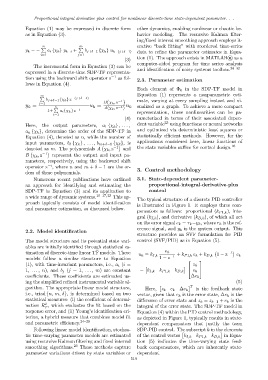
Equation (1) may be expressed in discrete form other dynamics, enabling nonlinear or chaotic be-
as in Equation (3). havior modeling. The recursive Kalman filter-
ing/fixed interval smoothing approach employs it-
n m erative “back fitting” with reordered time-series
P P
y k = − a i {χ k } y k−i + b j+δ−1 {χ k } u k−(j+δ−1) data to refine the parameter estimates in Equa-
i=1 j=1
(3) tion (1). The approach exists in MATLAB® as a
computer-aided program for time series analysis
The incremental form in Equation (3) can be 24–32
and identification of noisy systems toolbox.
expressed in a discrete-time SDP-TF representa-
tion using the backward shift operator z −1 as fol-
2.3. Parameter estimation
lows in Equation (4).
Each element of Φ k in the SDP-TF model in
Equation (1) represents a nonparametric esti-
m P
b j+δ−1 {χ k } z −(j+δ−1) B(χ k , z ) mate, varying at every sampling instant and vi-
−1
y = j=1 u = −1 u k sualized as a graph. To achieve a more compact
k
k
1+ n P a i {χ k } z −i A(χ k , z ) representation, these nonlinearities can be pa-
i=1
(4) rameterized in terms of their associated depen-
Here, the output parameters, a 1 {χ k } , . . . , dent variable 23 using functions or neural networks
a n {χ k }, determine the order of the SDP-TF in and optimized via deterministic least squares or
Equation (4), denoted as n, while the number of statistically efficient methods. However, for the
input parameters, b δ {χ k } , . . . , b m+δ−1 {χ k }, is applications considered here, linear functions of
denoted as m. The polynomials A χ k , z −1 and the state variables suffice for control design. 16
B χ k , z −1 represent the output and input pa-
rameters, respectively, using the backward shift
−i
operator z , where n and m + δ − 1 are the or-
ders of these polynomials. 3. Control methodology
Numerous recent publications have outlined 3.1. State-dependent parameter-
an approach for identifying and estimating the proportional-integral-derivative-plus
SDP-TF in Equation (3) and its application to control
a wide range of dynamic systems. 10–17,23 This ap- The typical structure of a discrete PID controller
proach typically consists of model identification is illustrated in Figure 1. It employs three com-
and parameter estimation, as discussed below.
pensators as follows: proportional (k P1,k ), inte-
gral (k I,k ), and derivative (k D,k ), of which all act
on the error signal e k = r k −y k , where r k is the ref-
erence signal, and y k is the system output. This
2.2. Model identification
structure provides an SVF formulation for PID
The model structure and its potential state vari- control (SVF/PID) as in Equation (5).
ables are initially identified through statistical es-
timation of discrete-time linear TF models. These e k −1
u k = k I,k + k P1,k e k + k D,k 1 − z e k
models follow a similar structure to Equation 1 − z −1
(1), with time-invariant parameters, i.e., a i (i = z k
1, . . . , n), and b j (j = 1, . . . , m) are constant = k I,k k P1,k k D,k e k
coefficients. These coefficients are estimated us- ∆e k
ing the simplified refined instrumental variable al- (5)
gorithm. The appropriate linear model structure, Here, z k e k ∆e k T is the feedback state
i.e., triad {n, m, δ}, is determined based on two vector, given that e k is the error state, ∆e k is the
statistical measures: (i) the coefficient of determi- difference of error state and z k = z k−1 + e k is the
2
nation R , which evaluates the fit based on the integral of the error state. The SDP-TF model in
T
response error, and (ii) Young’s identification cri- Equation (4) within the PID control methodology,
terion, a hybrid measure that combines model fit as depicted in Figure 1, typically results in state-
and parametric efficiency. 24–29 dependent compensators that justify the term
Following linear model identification, stochas- SDP-PID control. The subscript k in the elements
tic time-varying parameter models are estimated of the control vector k I,k k P1,k k D,k in Equa-
using recursive Kalman filtering and fixed interval tion (5) indicates the time-varying state feed-
smoothing algorithms. 23 These methods capture back compensators, which are inherently state-
parameter variations driven by state variables or dependent.
519

