


Page 164 - IJOCTA-15-3
P. 164
Pakchin et al. / IJOCTA, Vol.15, No.3, pp.535-548 (2025)
            with Caputo, 16  who investigated their applica-  More advanced frameworks, such as the alter-
            tion in describing stress–strain relationships in  nating direction implicit-Galerkin finite element
            viscoelastic media.  Subsequently, Caputo fur-    method, 39  finite element approximations, 40  and
            ther expanded on these models to include appli-   the shifted fractional Jacobi spectral algorithm 41
            cations in dielectric relaxation and anomalous dif-  have further expanded the toolbox for solving
            fusion phenomena. 17,18  Building upon this foun-  these models. Some studies have combined the
            dation, Chechkin et al. 19  introduced and ana-   finite difference method with the matrix transfer
            lyzed distributed-order time-fractional models in  technique to handle the space-fractional deriva-
            greater depth, further highlighting their effective-  tive in distributed-order models, 42  while others
            ness in representing physical systems that exhibit  have employed the shifted Legendre method 43  or
            a broad spectrum of dynamical behaviors.          introduced novel matrix representations of frac-
                                                              tional models. 44  Collectively, these methods re-
                Sokolov et al. 20  studied and introduced     flect the rich and diverse landscape of numerical
            distributed-order time-fractional models, also re-  strategies developed to tackle the inherent diffi-
            ferred to as diffusion-like models, to provide a ki-  culties in distributed-order fractional differential
            netic interpretation of anomalous diffusion and to  equations.
            describe relaxation phenomena. 21–24  Among these     In this work, we propose an efficient and
            models, the fractional telegraph equation has gar-
                                                              high-performance numerical method for solving
            nered significant attention due to its versatility in
                                                              the distributed-order time-fractional telegraph
            modeling various physical and mathematical phe-
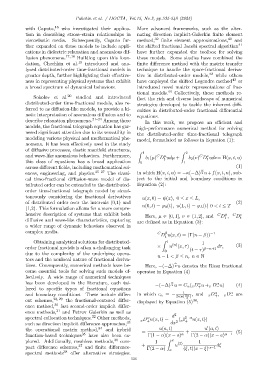
                                                              model, formulated as follows in Equation (1):
            nomena. It has been effectively used in the study
            of diffusive processes, elastic manifold structures,
                                                              Z  1               Z  2
            and wave-like anomalous behaviors. Furthermore,            C  µ               C  ν
                                                                  b 1 (µ) D udµ +    b 2 (ν) D udν= H(x, t, u)
                                                                          t
                                                                                             t
            this class of equations has a broad application    0                   1
            across different fields, including mathematical sci-                                          (1)
                                                                                          α
            ences, engineering, and physics. 25–27  The classi-  in which H(x, t, u) = −κ(−∆) 2 u+f(x, t, u), sub-
            cal time-fractional diffusion-wave model of dis-  ject to the initial and boundary conditions in
            tributed order can be extended to the distributed-  Equation (2):
            order time-fractional telegraph model by simul-
            taneously considering the fractional derivatives    u(x, 0) = ψ(x), 0 ≤ x ≤ L,
            of distributed order over the intervals (0,1) and                                             (2)
            (1,2). This formulation allows for a more compre-   u(0, t) = φ 0 (t), u(L, t) = φ L (t) 0 < t ≤ T
            hensive description of systems that exhibit both      Here, µ ∈ (0, 1], ν ∈ (1, 2], and  C D ,  C D ν
                                                                                                     µ
            diffusive and wave-like characteristics, capturing  are defined as in Equation (3):      t      t
            a wider range of dynamic behaviors observed in
            complex media.                                             C  β                   −1
                                                                        D u(x, t) = (Γ(n − β))
                                                                          t
                Obtaining analytical solutions for distributed-          Z  t              1
                                                                       ×    u (n) (x, τ)          dτ,     (3)
            order fractional models is often a challenging task                             β−n+1
                                                                          0          (t − τ)
            due to the complexity of the underlying opera-
                                                                       n − 1 < β ≤ n, n ∈ N
            tors and the nonlocal nature of fractional deriva-
                                                                               α
            tives. Consequently, numerical methods have be-       Here, −(−∆) 2 u denotes the Riesz fractional
            come essential tools for solving such models ef-  operator in Equation (4)
            fectively. A wide range of numerical techniques
            has been developed in the literature, each tai-           −(−∆) 2 u = C α ( x D u + x D u)    (4)
                                                                             α
                                                                                                 α
                                                                                         α
            lored to specific types of fractional equations                              +       −
                                                                                                α
            and boundary conditions. These include differ-    in which c α = − 2cos( 1 πα , and  x D ,  x D α  are
                                                                                                       −
                                                                                                +
                                                                                     )
                                                                                    2
            ent schemes, 28,29  the fractional-centered differ-  displayed by Equation (5) :
                                                                                       34
            ence method, 30  fast second-order implicit differ-
            ence methods, 31  and Petrov–Galerkin as well as                   2
                                                                  α
            spectral collocation techniques. 32  Other methods,  x D u(x, t) =  d  ( x I 2−α u(x, t))
                                                                  +
                                                                                   +
            such as direction implicit difference approaches, 33             dx 2
                                                                                             ′
            the operational matrix method,   34  and hybrid     =       u(a, t)    +        u (a, t)      (5)
            function-based techniques 35  have also been ex-       Γ(1 − α)(x − a) α  Γ(2 − α)(x − a) α−1
            plored. Additionally, meshless methods, 36  com-          1    Z  x  (2)     1
            pact difference schemes, 37  and finite difference-  +  Γ(2 − α)  a  u  (ξ, t)(x − ξ) α−1 dξ
            spectral methods 38  offer alternative strategies.
                                                           536

