


Page 165 - IJOCTA-15-3
P. 165
A numerical method for solving distributed-order multi-term time-fractional telegraph equations involving
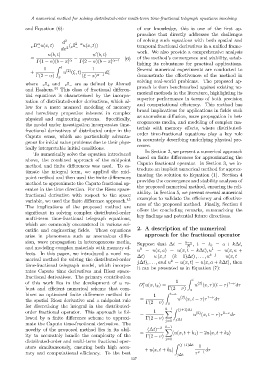
            and Equation (6):                                 of our knowledge, this is one of the first ap-
                                                              proaches that directly addresses the challenges
                             d 2  2−α                         of solving such equations with both spatial and
                  α
               x D u(x, t) =    ( x I −  u(x, t))             temporal fractional derivatives in a unified frame-
                  −
                            dx 2
                                           ′
                      u(b, t)             u (b, t)            work. We also provide a comprehensive analysis
               =                  −                     (6)   of the method’s convergence and stability, estab-
                 Γ(1 − α)(b − x) α  Γ(2 − α)(b − x) α−1
                                                              lishing its robustness for practical applications.
                    1     Z  b            1                   Several numerical experiments are conducted to
               +             u (2) (ξ, t)       dξ
                 Γ(2 − α)  x         (ξ − x) α−1              demonstrate the effectiveness of the method in
                                                              solving real-world problems. The proposed ap-
            where   x I + and  x I − are as defined by Ahmed
            and Hashem.  44  This class of fractional differen-  proach is then benchmarked against existing nu-
                                                              merical methods in the literature, highlighting its
            tial equations is characterized by the incorpo-
                                                              superior performance in terms of both precision
            ration of distributed-order derivatives, which al-
            low for a more nuanced modeling of memory         and computational efficiency. This method has
            and hereditary properties inherent in complex     broad implications for applications in fields such
            physical and engineering systems.   Specifically,  as anomalous diffusion, wave propagation in het-
            the model under investigation incorporates time-  erogeneous media, and modeling of complex ma-
            fractional derivatives of distributed order in the  terials with memory effects, where distributed-
            Caputo sense, which are particularly advanta-     order time-fractional equations play a key role
            geous for initial value problems due to their phys-  in accurately describing underlying physical pro-
            ically interpretable initial conditions.          cesses.
                                                                  In Section 2, we present a numerical approach
                To numerically solve the equation introduced
            above, the combined approach of the midpoint      based on finite differences for approximating the
            method and finite differences was used. To es-    Caputo fractional operator. In Section 3, we in-
            timate the integral term, we applied the mid-     troduce an implicit numerical method for approx-
            point method and then used the finite differences  imating the solution to Equation (1). Section 4
            method to approximate the Caputo fractional op-   provides the convergence and stability analyses of
            erator in the time direction. For the Riesz space-  the proposed numerical method, ensuring its reli-
            fractional derivative with respect to the space   ability. In Section 5, we present several numerical
            variable, we used the finite difference approach. 45  examples to validate the efficiency and effective-
                                                              ness of the proposed method. Finally, Section 6
            The implications of the proposed method are
                                                              offers the concluding remarks, summarizing the
            significant in solving complex distributed-order
                                                              key findings and potential future directions.
            multi-term time-fractional telegraph equations,
            which are commonly encountered in various sci-
                                                              2. A description of the numerical
            entific and engineering fields. These equations
            arise in phenomena such as anomalous diffu-          approach for the fractional operator
            sion, wave propagation in heterogeneous media,                         b−a
                                                              Suppose that ∆t =     N  , t = t k = a + k∆t,
            and modeling complex materials with memory ef-    u 0  = u(x, a) = u(x, t − k∆t), u 1  = u(x, a +
            fects. In this paper, we introduced a novel nu-   ∆t) = u (x, t − (k − 1)∆t) , . . . , u k−j  = u(x, t −
            merical method for solving the distributed-order  j∆t), . . . , and u = u(x, t) = u(x, a + k∆t), then
                                                                             k
            time-fractional telegraph model, which incorpo-   it can be presented as in Equation (7):
            rates Caputo time derivatives and Riesz space-
            fractional derivatives. The primary contribution                        Z  t
            of this work lies in the development of a ro-       ν              1         (2)           1−ν
                                                               D u(x, t k ) =           u  (x, τ)(t − τ)  dτ
                                                                t
            bust and efficient numerical scheme that com-                   Γ(2 − ν)  a
            bines an optimized finite difference method for          1    Z  t−a  (2)        1−ν
            the spatial Riesz derivative and a midpoint rule   =  Γ(2 − ν)      u  (x, t − τ)τ  dτ
            for discretizing the integral in the distributed-               0
            order fractional operator. This approach is fol-   =     1    k−1 Z  (j+1)∆t  u (2) (x, t − τ)τ  1−ν dτ
                                                                          X
            lowed by a finite difference scheme to approxi-       Γ(2 − ν)     j∆t
                                                                           j=0
            mate the Caputo time-fractional derivative. The
                                                                          k−1
            novelty of the proposed method lies in its abil-      (∆t) −2 X
                                                               =              (u(x, t + k 1 ) − 2u(x, t + k 2 )
            ity to accurately handle the complexity of the        Γ(2 − ν)
                                                                           j=0
            distributed-order and multi-term fractional oper-
                                                                               Z  (j+1)∆t
            ators simultaneously, ensuring both high accu-                               1
                                                                 + u(x, t + k 3 )           dτ
            racy and computational efficiency. To the best                      j∆t     τ ν−1
                                                           537

