


Page 173 - IJOCTA-15-3
P. 173
A numerical method for solving distributed-order multi-term time-fractional telegraph equations involving
                                                                                        2
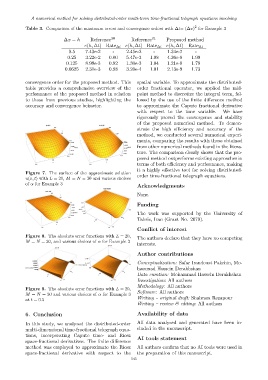
            Table 3. Comparison of the maximum errors and convergence orders with ∆t= (∆x) for Example 3
                             ∆x = h      Reference 30      Reference 31    Proposed method
                                       e(h, ∆t) Rate ∆t e(h, ∆t) Rate ∆t e(h, ∆t)    Rate ∆t
                                0.5    7.43e-2     -     2.45e-2     -     1.34e-7      -
                               0.25    3.22e-2    0.60   5.47e-3    1.08   4.36e-8    1.99
                              0.125    8.99e-3    0.92   1.30e-3    1.04   1.21e-8    1.78
                              0.0625   2.31e-3    0.98   3.20e-4    1.01   2.13e-9    1.73

            convergence order for the proposed method. This   spatial variable. To approximate the distributed-
            table provides a comprehensive overview of the    order fractional operator, we applied the mid-
            performance of the proposed method in relation    point method to discretize the integral term, fol-
            to those from previous studies, highlighting the  lowed by the use of the finite difference method
            accuracy and convergence behavior.                to approximate the Caputo fractional derivative
                                                              with respect to the time variable.    We have
                                                              rigorously proved the convergence and stability
                                                              of the proposed numerical method. To demon-
                                                              strate the high efficiency and accuracy of the
                                                              method, we conducted several numerical experi-
                                                              ments, comparing the results with those obtained
                                                              from other numerical methods found in the litera-
                                                              ture. The comparison clearly shows that the pro-
                                                              posed method outperforms existing approaches in
                                                              terms of both efficiency and performance, making
                                                              it a highly effective tool for solving distributed-
            Figure 7. The surface of the approximate solution  order time-fractional telegraph equations.
            u(x, t) with L = 20, M = N = 30 and various choices
            of α for Example 3
                                                              Acknowledgments
                                                              None.

                                                              Funding

                                                              The work was supported by the University of
                                                              Tabriz, Iran (Grant No. 2070).

                                                              Conflict of interest
            Figure 8. The absolute error functions with L = 20,  The authors declare that they have no competing
            M = N = 30, and various choices of α for Example 3
                                                              interests.

                                                              Author contributions
                                                              Conceptualization: Safar Irandoust Pakchin, Mo-
                                                              hammad Hossein Derakhshan
                                                              Data curation: Mohammad Hossein Derakhshan
                                                              Investigation: All authors
                                                              Methodology: All authors
            Figure 9. The absolute error functions with L = 20,
                                                              Software: All authors
            M = N = 30 and various choices of α for Example 3
            at t = 0.5                                        Writing – original draft: Shahram Rezapour
                                                              Writing – review & editing: All authors
            6. Conclusion                                     Availability of data

            In this study, we analyzed the distributed-order  All data analyzed and generated have been in-
            multi-dimensional time-fractional telegraph equa-  cluded in the manuscript.
            tions, incorporating Caputo time- and Riesz
                                                              AI tools statement
            space-fractional derivatives. The finite difference
            method was employed to approximate the Riesz      All authors confirm that no AI tools were used in
            space-fractional derivative with respect to the   the preparation of this manuscript.
                                                           545

