


Page 172 - IJOCTA-15-3
P. 172
Pakchin et al. / IJOCTA, Vol.15, No.3, pp.535-548 (2025)
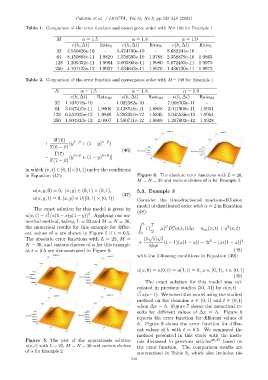
            Table 1. Comparison of the error function and convergence order with N= 100 for Example 1

                          M          α = 1.5                α = 1.8               α = 1.9
                                 e(h, ∆t)    Rate h    e(h, ∆t)    Rate h     e(h, ∆t)    Rate h
                          32   2.550426e-10     -    5.474700e-10     -    8.682241e-10     -
                          64   8.150868e-11 1.9820 1.558595e-10 1.9788 2.358879e-10 1.9863
                          128 1.205352e-11 1.9984 3.065866e-11 1.9980 5.072403e-11 1.9970
                          256 4.701125e-12 1.9937 1.034642e-11 1.9970 1.436730e-11 1.9972


            Table 2. Comparison of the error function and convergence order with M= 100 for Example 1

                         N           α = 1.5                α = 1.8               α = 1.9
                                e(h, ∆t)    Rate ∆t    e(h, ∆t)    Rate ∆t    e(h, ∆t)    Rate ∆t
                         32   1.104018e-10     -     1.002382e-10     -     7.008703e-11     -
                         64   3.047415e-11  1.9900   2.438518e-11  1.8808   2.011908e-11  1.9931
                         128 6.557025e-12   1.9949   5.282357e-12  1.8845   5.045536e-12  1.9954
                         256 1.804933e-12   2.0007   1.500711e-12  1.8868   1.267602e-12  1.9928


                         3Γ(6)
                     +          (y 5−β  + (1 − y) 5−β )
                       Γ(6 − β)
                                                       (46)
                         Γ(7)
                     −          (y 6−β  + (1 − y) 6−β )]
                       Γ(7 − β)
            in which (x, t) ∈ [0, 1]×[0, 1] under the conditions
            in Equation (47):                                 Figure 6. The absolute error functions with L = 20,
                                                              M = N = 30 and various choices of α for Example 2
                u(x, y, 0) = 0, (x, y) ∈ (0, 1) × (0, 1),     5.3. Example 3
                                                       (47)
                u(x, y, t) = 0, (x, y) ∈ ∂((0, 1) × (0, 1))
                                                              Consider the time-fractional reaction-diffusion
                                                              model of distributed order with α = 2 in Equation
                The exact solution for this model is given by
                      5                                       (48):
                                        3
            u(x, t) = t 2 (x(1 − x)y(1 − y)) . Applying our nu-
            merical method, taking L = 20 and M = N = 30,
                                                                1   7
                                                              Z
                                                                              µ
            the numerical results for this example for differ-    Γ( − µ) D u(x, t)dµ = u xx (x, t) + u (x, t)
                                                                                                      2
                                                                          C
                                                                              t
            ent values of α are shown in Figure 5 if t = 0.5.   0   2
                                                                   √ √
            The absolute error functions with L = 20, M =        15 πt t
                                                                                              5
                                                              +           (t − 1)(x(1 − x)) − 2t − (xt(1 − x)) 2
            N = 30, and various choices of α for this example      8lnt
            at t = 0.5 are demonstrated in Figure 6.                                                     (48)
                                                              with the following conditions in Equation (49):
                                                              u(x, 0) = u(0, t) = u(1, t) = 0, x ∈ (0, 1), t ∈ (0, 1]
                                                                                                         (49)
                                                                  The exact solution for this model was cal-
                                                              culated in previous studies [30, 31] by u(x, t) =
                                                               5
                                                              t 2 x(x−1). We solved this model using the studied
                                                              method on the domains x ∈ (0, 1) and t ∈ (0, 1]
                                                              when ∆x = h. Figure 7 shows the numerical re-
                                                              sults for different values of ∆x = h. Figure 8
                                                              reports the error function for different values of
                                                              h. Figure 9 shows the error function for differ-
                                                              ent values of h with t = 0.5. We compared the
                                                              method presented in this study with the meth-
            Figure 5. The plot of the approximate solution    ods discussed in previous articles 46,47  based on
            u(x, t) with L = 20, M = N = 30 and various choices  the error function. The comparison results are
            of α for Example 2
                                                              summarized in Table 3, which also includes the
                                                           544

