


Page 171 - IJOCTA-15-3
P. 171
A numerical method for solving distributed-order multi-term time-fractional telegraph equations involving
            discrepancy between the approximate and exact
            solutions, providing a clear indication of the accu-
            racy of the numerical method. The absolute error
            is an essential metric for evaluating the effective-
            ness of the approximation, and these graphs help
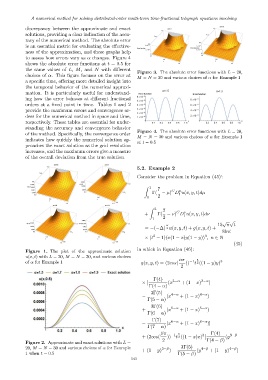
            to assess how errors vary as α changes. Figure 4
            shows the absolute error functions at t = 0.5 for
            the same values of L, M, and N with different
                                                              Figure 3. The absolute error functions with L = 20,
            choices of α. This figure focuses on the error at
                                                              M = N = 30 and various choices of α for Example 1
            a specific time, offering more detailed insight into
            the temporal behavior of the numerical approxi-
            mation. It is particularly useful for understand-
            ing how the error behaves at different fractional
            orders at a fixed point in time. Tables 1 and 2
            provide the maximum errors and convergence or-
            ders for the numerical method in space and time,
            respectively. These tables are essential for under-
            standing the accuracy and convergence behavior
                                                              Figure 4. The absolute error functions with L = 20,
            of the method. Specifically, the convergence order
                                                              M = N = 30 and various choices of α for Example 1
            indicates how quickly the numerical solution ap-
                                                              at t = 0.5
            proaches the exact solution as the grid resolution
            increases, and the maximum errors give a measure
            of the overall deviation from the true solution.

                                                              5.2. Example 2
                                                              Consider the problem in Equation (45)‘:


                                                                   1   7
                                                                 Z
                                                                                 µ
                                                                             C
                                                                     Γ( − µ) D u(x, y, t)dµ
                                                                                t
                                                                  0    2
                                                                   Z  2  7
                                                                               C
                                                                                   ν
                                                                 +     Γ( − ν) D u(x, y, t)dν
                                                                                   t
                                                                     1   2
                                                                                                    √ √
                                                                           α                      15 π t
                                                                 = −(−∆) 2 u(x, y, t) + g(x, y, t) +
                                                                                                    8lnt
                                                                     2                      3
                                                                 × (t − 1)(x(1 − x)y(1 − y)) , n ∈ N
                                                                                                         (45)
                                                              in which in Equation (46):
            Figure 1. The plot of the approximate solution
            u(x, t) with L = 20, M = N = 30, and various choices
                                                                                 απ     5
            of α for Example 1                                  g(x, y, t) = (2cos(  )) −1 t 2 ((1 − y)y) 3
                                                                                 2
                                                                     Γ(4)     3−α         3−α
                                                                × [         (x    + (1 − x)   )
                                                                   Γ(4 − α)
                                                                    3Γ(5)    4−α          4−α
                                                                −          (x    + (1 − x)   )
                                                                   Γ(5 − α)
                                                                    3Γ(6)    5−α          5−α
                                                                +          (x    + (1 − x)   )
                                                                   Γ(6 − α)
                                                                     Γ(7)    6−α          6−α
                                                                −          (x    + (1 − x)   )]
                                                                   Γ(7 − α)
                                                                        βπ   −1  5         3   Γ(4)    3−β
                                                                + (2cos(   ))  t 2 ((1 − x)x) [      (y
                                                                         2                   Γ(4 − β)
            Figure 2. Approximate and exact solutions with L =
            20, M = N = 30 and various choices of α for Example  + (1 − y) 3−β ) −  3Γ(5)  (y 4−β  + (1 − y) 4−β )
            1 when t = 0.5                                                      Γ(5 − β)
                                                           543

