


Page 124 - IJOCTA-15-4
P. 124
Zhang et al. / IJOCTA, Vol.15, No.4, pp.649-669 (2025)
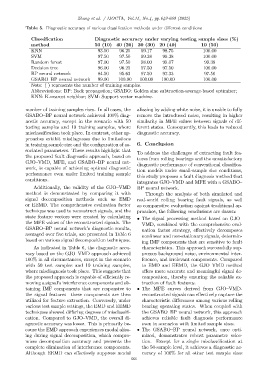
            Table 5. Diagnostic accuracy of various classification methods under different conditions

               Classification              Diagnostic accuracy under varying testing sample sizes (%)
               method                      50 (10) 40 (20) 30 (30) 20 (40)                10 (50)
               KNN                           93.50    96.25     99.17    98.75             100.00
               SVM                           97.50    97.50     99.38    99.38             100.00
               Random forest                 97.00    97.50     98.00    99.07              99.38
               Decision tree                 96.00    96.25     97.50    97.50             100.00
               BP neural network             84.50    95.63     97.50    97.33              97.50
               GSABO–BP neural network       99.00    100.00   100.00    100.00            100.00
               Note: ( ) represents the number of training samples.
               Abbreviations: BP: Back propagation; GSABO: Golden sine subtraction-average-based optimizer;
               KNN: K-nearest neighbor; SVM: Support vector machine.


            number of training samples rises. In all cases, the  aliasing by adding white noise, it is unable to fully
            GSABO–BP neural network achieved 100% diag-       remove the introduced noise, resulting in higher
            nostic accuracy, except in the scenario with 50   similarity in MFE values between signals of dif-
            testing samples and 10 training samples, where    ferent states. Consequently, this leads to reduced
            misclassification took place. In contrast, other ap-  diagnostic accuracy.
            proaches exhibit misdiagnoses due to limitations
            in training sample size and the configuration of as-  6. Conclusion
            sociated parameters. These results highlight that  To address the challenges of extracting fault fea-
            the proposed fault diagnostic approach, based on  tures from rolling bearings and the unsatisfactory
            GJO–VMD, MFE, and GSABO–BP neural net-            diagnostic performance of conventional classifica-
            work, is capable of achieving optimal diagnostic  tion models under small-sample size conditions,
            performance even under limited training sample
                                                              this study proposes a fault diagnosis method that
            conditions.
                                                              integrates GJO–VMD and MFE with a GSABO–
                Additionally, the validity of the GJO–VMD     BP neural network.
            method is demonstrated by comparing it with           Through the analysis of both simulated and
            signal decomposition methods such as EMD          real-world rolling bearing fault signals, as well
            or EEMD. The comprehensive evaluation factor      as comparative evaluation against traditional ap-
            technique was used to reconstruct signals, and the  proaches, the following conclusions are drawn:
            state feature vectors were created by calculating
                                                              • The signal processing method based on GJO–
            the MFE values of the reconstructed signals. The
                                                                VMD, combined with the comprehensive eval-
            GSABO–BP neural network’s diagnostic results,
                                                                uation factor strategy, effectively decomposes
            averaged over five trials, are presented in Table 6
                                                                nonlinear and non-stationary signals, determin-
            based on various signal decomposition techniques.
                                                                ing IMF components that are sensitive to fault
                As indicated in Table 6, the diagnostic accu-   characteristics. This approach successfully sup-
            racy based on the GJO–VMD approach achieved         presses background noise, environmental inter-
            100% in all circumstances, except in the scenario   ference, and irrelevant components. Compared
            with 50 test samples and 10 training samples,       to EMD and EEMD, the GJO–VMD method
            where misdiagnosis took place. This suggests that   offers more accurate and meaningful signal de-
            the proposed approach is capable of efficiently re-  composition, thereby ensuring the reliable ex-
            moving a signal’s interference components and ob-   traction of fault features.
            taining IMF components that are responsive to     • The MFE curves derived from GJO–VMD-
            the signal features—these components are then       reconstructed signals can effectively capture the
            utilized for feature extraction. Conversely, under  characteristic differences among various rolling
            various test sample settings, the EMD and EEMD      bearing operating states. When coupled with
            techniques showed differing degrees of misclassifi-  the GSABO–BP neural network, this approach
            cation. Compared to GJO–VMD, the overall di-        achieves reliable fault diagnosis performance
            agnostic accuracy was lower. This is primarily be-  even in scenarios with limited sample sizes.
            cause the EMD approach experiences modal alias-   • The GSABO–BP neural network, once opti-
            ing during signal decomposition, which compro-      mized, demonstrates robust parameter selec-
            mises decomposition accuracy and prevents the       tion. Except for a single misclassification at
            complete elimination of interference components.    the 50-sample level, it achieves a diagnostic ac-
            Although EEMD can effectively suppress modal        curacy of 100% for all other test sample sizes
                                                           666

