


Page 77 - IJOCTA-15-4
P. 77
Analysis and analytical solution of incommensurate fuzzy fractional nabla difference systems...
Therefore, their r-cat boundaries can be described from Equation (43) we obtain
by ˜
˜
√ √ d 1 (0) =q 1 (0.2) = 0.5498,
C x 1 (0) (r) =[d 1 − ϵ 1 − r, d 1 + ϵ 1 − r] ˜ [0] √
˜
∗
=[C x 1 (0)∗ (r), C x 1 (0)(r) ] (54) f (r) =0.5498 − q 1 (0.2 − 2ϵ( 1 − r + 1 − r)),
1
√
˜ [0]
[0] [0] ˜ g (r) =q 1 (0.2 + 2ϵ( 1 − r + 1 − r)) − 0.5498.
=[d 1 − f (r), d 1 + g (r)]. 1
1 1
(60)
Since the unique deterministic value of x 1 (0)(w) is
Equation (60) represents a transformation that
d 1 [0] = d 1 , the shape functions in U are obtained
takes into account the effect of the sigmoid acti-
by
√ vation function on the shape functions. Clearly,
[0] [0]
f (r) = g (r) = ϵ 1 − r, (55) ˜ ˜ [0]
˜ [0]
1 1 f (1) = ˜g (1) = 0 as expected.
1
1
The shape functions and r-cuts of fuzzy number
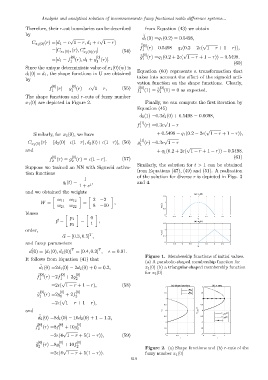
x 1 (0) are depicted in Figure 2. Finally, we can compute the first iteration by
Equation (45)
d 1 (1) =0.3d 1 (0) + 0.5498 = 0.6698,
√
[1]
f (r) =0.3ϵ 1 − r
1
√
Similarly, for x 2 (0), we have + 0.5498 − q 1 (0.2 − 2ϵ( 1 − r + 1 − r)),
√
[1]
C x 2 (0) (r) = [d 2 (0)−ϵ(1−r), d 2 (0)+ϵ(1−r)], (56) g (r) =0.3ϵ 1 − r
1
√
and + q 1 (0.2 + 2ϵ( 1 − r + 1 − r)) − 0.5498.
[0] [0] (61)
f (r) = g (r) = ϵ(1 − r). (57)
2
2
Similarly, the solution for t > 1 can be obtained
Suppose we trained an NN with Sigmoid activa-
tion functions from Equations (47), (49) and (51). A realization
of the solution for diverse r is depicted in Figs. 3
1
q i (t) = , and 4.
1 + e t
and we obtained the weights
(a): x 1 (0)
1.5
w 11 w 12 2 −2
W = = , (w) 1
w 21 w 22 8 −10
r=
0.5
biases
0 -1 -0.5 0 0.5 1 1.5 2 2.5 3
p 1 0 w
⃗ p = = , (b): x 2 (0)
p 2 1 1.5
order, (w) 1
T
⃗ α = [0.3, 0.5] , r= 0.5
and fuzzy parameters 0 -1 -0.5 0 0.5 1 1.5 2 2.5 3
w
⃗
T
T
d(0) = [d 1 (0), d 2 (0)] = [0.4, 0.3] , ϵ = 0.01.
Figure 1. Membership functions of initial values.
It follows from Equation (41) that
(a) A parabolic-shaped membership function for
˜
d 1 (0) =2d 1 (0) − 2d 2 (0) + 0 = 0.2, x 1 (0) (b) a triangular-shaped membership function
for x 2 (0)
[0]
[0]
[0]
˜
f (r) =2f + 2g
1 1 2
√
=2ϵ( 1 − r + 1 − r), (58) (a): Shape functions (b): r- cuts
2 2
[0]
-f 1 (r)
[0] [0] [0] [0]
˜ g (r) =2g + 2f 1.5 g 1 (r) 1.5
1 1 2
√ 1 1
=2ϵ( 1 − r + 1 − r),
0.5 0.5
and f(r) 0 C x 1 (0) (r) 0 C x 1 (0)* (r)
˜
d 2 (0) =8d 1 (0) − 10d 2 (0) + 1 = 1.2, -0.5 -0.5 C x 1 (0) (r)
*
d 1
-1 -1
[0]
˜
f (r) =8f [0] + 10g [0]
2 1 2 -1.5 -1.5
√
=2ϵ(4 1 − r + 5(1 − r)), (59) -2 0 0.5 1 -2 0 0.5 1
r r
[0] [0] [0]
˜ g (r) =8g + 10f
2 1 2
√ Figure 2. (a) Shape functions and (b) r-cuts of the
=2ϵ(4 1 − r + 5(1 − r)). fuzzy number x 1 (0)
619

