


Page 79 - IJOCTA-15-4
P. 79
Analysis and analytical solution of incommensurate fuzzy fractional nabla difference systems...
            and
                                                                       0.8
                  ∂x i (1)     ′
                         = δ ij q (z i (0)),  i, j = 1, 2.  (72)       0.6
                              i
                   ∂p j
            Here, T represents the memory length of the NN.           i  0.4
                The incommensurate NN Equation (62) is                i  0.2
                                                       ⃗
            trained to obtain ⃗x(T). Inputs are ⃗x {s} (0) = i(s)    C x i (2) (r)=[d [2] -f [2] (r),d [2] +g [2] (r)]  i  i  0
            for s = 0, . . . , n, (where n is the number of data
            points). In time series analysis, this can be inter-       -0.2
            preted as predicting the time series at s + T.             -0.4
                             {s}                        {s}
                The goal is x   (T) to match real data y   ,
                             i                          i              -0.6
                                     ⃗
            Corresponds to predicting i(s + c), (with c = 1 or           0     0.2    0.4  r  0.6  0.8    1
            c = T). As is conventional, the training energy
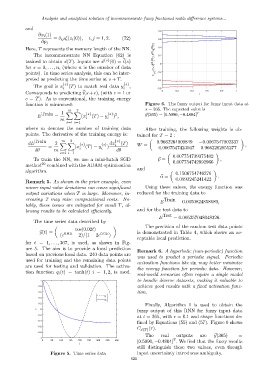
            function is minimized:                                Figure 6. The fuzzy output for fuzzy input data at
                               m   2                              s = 365. The expected value is
                   Train    1  X X     {s}       {s} 2            ⃗y(365) = [0.5090, −0.4804] T
                  E      =           (x   (T) − y  ) ,
                            m          i         i
                              s=1 i=1
            where m denotes the number of training data           After training, the following weights is ob-
            points. The derivative of the training energy is:  tained for T = 2 :

                            m
                                                    {s}
                                2
              dE Train   2  X X     {s}       {s} dx   (T)             0.9662264009849   −0.0067547002337
                       =          (x   (T) − y   )  i         W =     −0.0067547423047    0.9662262855277     ,
                dθ       m          i         i      dθ
                            s=1 i=1
                                                                              0.007754739375402
                To train the NN, we use a mini-batch SGD               ⃗ p =  0.007754742992966    ,
            method  29  combined with the ADAM optimization
                                                              and
            algorithm.                                                        0.1506754746276
                                                                        ⃗ α =                     .
            Remark 5. As shown in the prior example, even                      0.0993245241422
            minor input value deviations can cause significant    Using these values, the energy function was
            output variations when T is large. Moreover, in-  reduced for the training data to
            creasing T may raise computational costs. No-                 Train
                                                                        E       = 0.0050824858689,
            tably, these issues are mitigated for small T, al-
            lowing results to be calculated efficiently.      and for the test data to
                                                                         Test
                                                                        E     = 0.005257048048326.
                The time series data described by
                                                                  The precision of the random test data points

                                  cos(0.02t)
                   ⃗y(t) =    0.01t           0.01t           is demonstrated in Table 4, which shows an ac-
                            (e    − 2)/(1 − 2e   )
                                                              ceptable local prediction.
            for t = 1, . . . , 367, is used, as shown in Fig-
            ure 5. The aim is to provide a local prediction
                                                              Remark 6. A hyperbolic (non-periodic) function
            based on previous local data. 240 data points are
                                                              was used to predict a periodic signal. Periodic
            used for training and the remaining data points
                                                              activation functions like sin may better minimize
            are used for testing and validation. The activa-
                                                              the energy function for periodic data. However,
            tion function q i (t) = tanh(t) i = 1, 2, is used.
                                                              real-world scenarios often require a single model
                   1                                          to handle diverse datasets, making it valuable to
                  0.8                                         achieve good results with a fixed activation func-
                                                              tion.
                  0.6
                                               y
                  0.4                           1
                                               y
                                                2
                  0.2
                                                                  Finally, Algorithm 1 is used to obtain the
                 y  0
                                                              fuzzy output of this RNN for fuzzy input data
                  -0.2
                                                              at t = 365, with ϵ = 0.1 and shape functions de-
                  -0.4
                                                              fined by Equations (55) and (57). Figure 6 shows
                  -0.6
                                                              C ⃗x(T) (r).
                  -0.8
                                                                  The    real  outputs    are   ⃗y(365)    =
                   -1
                                                                              T
                    0   50  100  150  200  250  300  350  400  [0.5090, −0.4804] . We find that the fuzzy results
                                    t
                                                              still distinguish these two values, even though
                       Figure 5. Time series data             input uncertainty introduces ambiguity.
                                                           621

