


Page 100 - IJPS-2-2
P. 100
Decomposing the Socio-economic Inequalities in Utilization of Full Antenatal Care in Jharkhand State, India


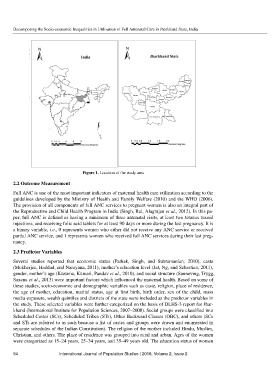
                                    Figure 1. Location of the study area

       2.2 Outcome Measurement
       Full ANC is one of the most important indicators of maternal health care utilization according to the
       guidelines developed by the Ministry of Health and Family Welfare (2010) and the WHO (2006).
       The provision of all components of full ANC services to pregnant women is also an integral part of
       the Reproductive and Child Health Program in India (Singh, Rai, Alagrajan et al., 2012). In this pa-
       per, full ANC is defined as having a minimum of three antenatal visits, at least two tetanus toxoid
       injections, and receiving folic acid tablets for at least 90 days or more during the last pregnancy. It is
       a binary variable, i.e., 0 represents women who either did not receive any ANC service or received
       partial ANC service, and 1 represents women who received full ANC services during their last preg-
       nancy.

       2.3 Predictor Variables
       Several studies reported  that  economic status (Pathak, Singh, and Subramanian,  2010), caste
       (Mukherjee, Haddad, and Narayana, 2011), mother’s education level (Jat, Ng, and Sebastian, 2011),
       gender, mother’s age (Kusuma, Kumari, Pandav et al., 2010), and social structure (Sanneving, Trygg,
       Saxena et al., 2013) were important factors which influenced the maternal health. Based on some of
       these studies, socio-economic and demographic variables such as caste, religion, place of residence,
       the age of  mother, education, marital status, age at first birth, birth order, sex of the child, mass
       media exposure, wealth quintiles and districts of the state were included as the predictor variables in
       the study. These selected variables were further categorized on the basis of DLHS-3 report for Jhar-
       khand (International Institute for Population Sciences, 2007–2008). Social groups were classified into
       Scheduled Castes (SCs), Scheduled Tribes (STs), Other Backward Classes (OBC), and others (SCs
       and STs are referred to as such because a list of castes and groups were drawn and enumerated in
       separate schedules of the Indian Constitution). The religion of the mother included Hindu, Muslim,
       Christian, and others. The place of residence was grouped into rural and urban. Ages of the women
       were categorized as 15–24 years, 25–34 years, and 35–49 years old. The education status of women

       94                 International Journal of Population Studies | 2016, Volume 2, Issue 2

