


Page 102 - IJPS-2-2
P. 102
Decomposing the Socio-economic Inequalities in Utilization of Full Antenatal Care in Jharkhand State, India
2.4.2 Decomposition of Concentration Index
The method proposed by Wagstaff and colleagues (1991) is used to decompose the socio-economic
inequality in full ANC utilization. This method has also been used by other scholars in identifying
the contributing factors in maternal health (Goli, Doshi, and Perianayagam, 2013; Hosseinpoor,
VanDoorslaer, Speybroeck et al., 2006). A decomposition method has an advantage over linear and
non-linear regression models as it allows one to estimate the relative contribution of factors to ine-
quality in a health variable (e.g., the gap between poor and rich). For a linear additive regression
model; the full ANC utilization variable Y is presented in terms of the intercept α , the rela-
i
tive contribution of X factors and residual error term ε in equation (3) below.
i
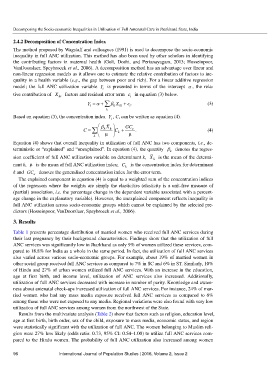
ki
Y = i α ∑ β + k X + ki i . ε (3)
k
Based on equation (3), the concentration index Y , C, can be written as equation (4).
i
C = ∑ β k X k C + GC ε . (4)
k
k µ μ
Equation (4) shows that overall inequality in utilization of full ANC has two components, i.e., de-
terministic or “explained” and “unexplained”. In equation (4), the quantity β denotes the regres-
k
sion coefficient of full ANC utilization variable on determinant k, X is the mean of the determi-
k
nant k, μ is the mean of full ANC utilization index; C is the concentration index for determinant
k
k and GC denotes the generalised concentration index for the error term.
ε
The explained component in equation (4) is equal to a weighted sum of the concentration indices
of the regressors where the weights are simply the elasticities (elasticity is a unit-free measure of
(partial) association, i.e. the percentage change in the dependent variable associated with a percent-
age change in the explanatory variable). However, the unexplained component reflects inequality in
full ANC utilization across socio-economic groups which cannot be explained by the selected pre-
dictors (Hosseinpoor, VanDoorslaer, Speybroeck et al., 2006).
3. Results
Table 1 presents percentage distribution of married women who received full ANC services during
their last pregnancy by their background characteristics. Findings show that the utilization of full
ANC services was significantly low in Jharkhand as only 9% of women utilized these services, com-
pared to 18.8% for India as a whole in the same period. In fact, the utilization of full ANC services
also varied across various socio-economic groups. For example, about 19% of married women in
other social group received full ANC services as compared to 7% in SC and 6% in ST. Similarly, 10%
of Hindu and 27% of urban women utilized full ANC services. With an increase in the education,
age at first birth, and income level, utilization of ANC services also increased. Additionally,
utilization of full ANC services decreased with increase in number of parity. Knowledge and aware-
ness about antenatal check-ups increased utilization of full ANC services. For instance, 24% of mar-
ried women who had any mass media exposure received full ANC services as compared to 6%
among those who were not exposed to any media. Regional variations were also found with very low
utilization of full ANC services among women from the northwest of the State.
Results from the multivariate analysis (Table 2) show that factors such as religion, education level,
age at first birth, birth order, sex of the child, exposure to mass media, economic status, and region
were statistically significant with the utilization of full ANC. The women belonging to Muslim reli-
gion were 27% less likely (odds ratio: 0.73, 95% CI: 0.54–1.00) to utilize full ANC services com-
pared to the Hindu women. The probability of full ANC utilization also increased among women
96 International Journal of Population Studies | 2016, Volume 2, Issue 2

