


Page 103 - IJPS-2-2
P. 103
Abha Gupta, Pushpendra Kumar and Olalemi Adewumi Dorcas

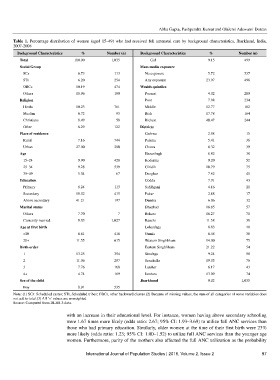
       Table 1.  Percentage distribution of women (aged 15–49) who  had  received full antenatal  care  by  background  characteristics, Jharkhand, India,
       2007-2008
        Background Characteristics   %         Number (n)    Background Characteristics   %            Number (n)
         Total                   100.00         1,035            Girl                    9.15            499
         Social Group                                        Mass media exposure
           SCs                    6.73            113          No exposure               5.72            537
           STs                    6.20            254          Any exposure              23.97           498
           OBCs                  10.19            474        Wealth quintiles
           Others                18.96            189          Poorest                   4.02            209
         Religion                                              Poor                      7.08            234
           Hindu                 10.23            761          Middle                    12.77           182
           Muslim                 6.72            93           Rich                      17.78           164
           Christians             8.49            58           Richest                   40.47           244
           Other                  6.29            122        Districts
         Place of residence                                    Garhwa                    2.88             15
           Rural                  7.16            744          Palamu                    5.41             36
           Urban                 27.00            290          Chatra                    6.32             39
         Age                                                   Hazaribagh                8.82             38
           15–24                  9.90            428          Kodarma                   9.20             52
           25–34                  9.28            539          Giridih                   10.79            75
           35–49                  5.04            67           Deoghar                   7.62             41
         Education                                             Godda                     7.91             43
           Primary                8.24            113          Sahibganj                 4.16             21
           Secondary             18.02            415          Pakur                     2.88             17
           Above secondary       41.21            197          Dumka                     6.06             32
         Marital status                                        Dhanbad                   16.85            57
           Others                 7.70             7           Bokaro                    16.27            71
           Currently married      9.03          1,027          Ranchi                    11.58            38
         Age at first birth                                    Lohardaga                 8.83             40
           <20                    6.81            416          Gumla                     6.48             36
           20+                   11.55            615          Western Singhbhum         14.00            75
         Birth order                                           Eastern Singhbhum         21.22            54
           1                     13.25            394          Simdega                   9.24             50
           2                     11.06            297          Seraikella                19.05            76
           3                      7.76            168          Latehar                   6.17             43
           4+                     4.74            169          Jamtara                   13.09            74
         Sex of the child                                    Jharkhand                   9.02           1,035
           Boy                    8.91            535
       Note: (1) SCs: Scheduled castes; STs, Scheduled tribes; OBCs, other backward classes.(2) Because of missing values, the sum of all categories of some variables does
       not add to total.(3) All ‘n’ values are unweighted
       Source: Computed from DLHS-3 data.

                             with an increase in their educational level. For instance, women having above secondary schooling
                             were 1.67 times more likely (odds ratio: 2.67; 95% CI: 1.93–3.69) to utilize full ANC services than
                             those who had primary education. Similarly, older women at the time of their first birth were 23%
                             more likely (odds ratio: 1.23; 95% CI: 1.00–1.52) to utilize full ANC services than the younger age
                             women. Furthermore, parity of the mothers also affected the full ANC utilization as the probability

                                     International Journal of Population Studies | 2016, Volume 2, Issue 2      97

