


Page 104 - IJPS-2-2
P. 104
Decomposing the Socio-economic Inequalities in Utilization of Full Antenatal Care in Jharkhand State, India

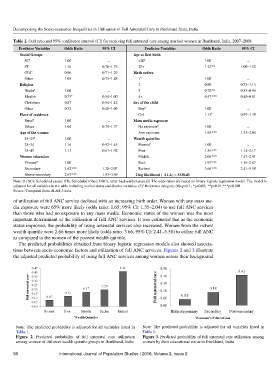
       Table 2. Odd ratio and 95% confidence interval (CI) for receiving full antenatal care among married women in Jharkhand, India, 2007–2008
         Predictor Variables   Odds Ratio    95% CI            Predictor Variables     Odds Ratio       95% CI
          Social Groups                                   Age at first birth
           SC   a            1.00              −            <20   a                     1.00              −
           ST                1.16            0.76–1.76      20+                         1.23**         1.00–1.52
           OBC               0.96            0.71–1.29    Birth orders
           Other             1.05            0.75–1.48      1   a                       1.00              −
          Religion                                          2                           0.90           0.73–1.13
           Hindu a           1.00              −            3                           0.70**         0.53–0.94
           Muslim            0.73   +        0.54–1.00      4+                          0.57***        0.40–0.81
           Christians        0.87            0.54–1.42    Sex of the child
           Other             0.72            0.48–1.09      Boy   a                     1.00              −
                                                                                           +
          Place of residence                                Girl                        1.15           0.97–1.38
           Rural a           1.00              −          Mass media exposure
           Urban             1.04            0.79–1.37      No exposure   a             1.00              −
          Age of the women                                  Any exposure                1.65***        1.35–2.04
           15–25   a         1.00              −          Wealth quintiles
           25–34             1.16            0.92–1.45      Poorest   a                 1.00              −
           35–49             1.13            0.67–1.92      Poor                        1.56***        1.14–2.17
          Women education                                   Middle                      2.06***        1.47–2.91
                 a
           Primary           1.00              −            Rich                        1.97***        1.36–2.87
           Secondary         1.62***         1.28–2.07      Richest                     3.66***        2.41–5.58
           Above secondary   2.67***         1.93–3.69    −2 log likelihood (−2 LL) = 3338.43
       Note: (1) SCs: Scheduled castes; STs, Scheduled tribes; OBCs, other backward classes.(2) The odds ratios are based on binary logistic regression model. The model is
                                                              a
       adjusted for all variables in the table including marital status and district variables. (3)  Reference category. (4)+p<0.1; *p<0.05; **p<0.01;***p<0.001.
       Source: Computed from DLHS-3 data.

       of utilization of full ANC service declined with an increasing birth order. Women with any mass me-
       dia exposure were 65% more likely (odds ratio: 1.65; 95% CI: 1.35–2.04) to use full ANC services
       than those who had no exposure to any mass media. Economic status of the women was the most
       important determinant of the utilization of full ANC services. It was estimated that as the economic
       status improved, the probability of using antenatal services also increased. Women from the richest
       wealth quintile were 2.66 times more likely (odds ratio: 3.66; 95% CI: 2.41–5.58) to utilize full ANC
       as compared to the women of the poorest wealth quintile.
         The predicted probabilities obtained from binary logistic regression models also showed associa-
       tions between socio-economic factors and utilization of full ANC services. Figures 2 and 3 illustrate
       the adjusted predicted probability of using full ANC services among women across their background


        Note: The predicted probability is adjusted for all variables listed in   Note: The predicted probability is adjusted for  all variables listed in
        Table 1.                                              Table 1.
        Figure  2.  Predicted  probability of  full antenatal  care utilization   Figure 3. Predicted probability of full antenatal care utilization among
        among women of different wealth quintile groups in Jharkhand, India   women by their educational status in Jharkhand, India

       98                 International Journal of Population Studies | 2016, Volume 2, Issue 2

