


Page 105 - IJPS-2-2
P. 105
Abha Gupta, Pushpendra Kumar and Olalemi Adewumi Dorcas

                             characteristics. Figure 2 indicates that the predicted probability of using full ANC services increased
                             with an increase in the economic status of women. For example, the probability of full ANC utiliza-
                             tion among women from the richest wealth quintiles was the highest (0.41) compared to the women
                             from the poorest quintiles (0.07). A similar gradient pattern was found for education, with the proba-
                             bility of full ANC utilization highest among women who had post-secondary education (0.41), fol-
                             lowed by those who had secondary education (0.18) and those who had primary or had no formal
                             education (0.08) (Figure 3).
                                Table 3 presents results for decomposing the concentration index for ANC inequality. Decomposi-
                             tion analysis shows that the estimated value of the relative contribution to the concentration index
                             was negative in some selected socio-economic factors such as poor economic status (concentration
                             index=  −0.10), SC/ST social  groups (concentration index=  −0.01),  Hindu religion (concentration
                             index= −0.01), and residence in rural area (concentration index = −0.04). Therefore, it reflected that
                             weaker socio-economic groups in Jharkhand were more disadvantaged in accessing full ANC services.
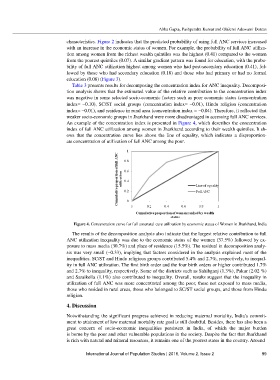
                             An example of the concentration index is presented in Figure 4, which describes the concentration
                             index of full ANC utilization among women in Jharkhand according to their wealth quintiles. It sh-
                             ows that the  concentration curve lies above the line  of equality, which  indicates  a disproportion-
                             ate concentration of utilization of full ANC among the poor.


                                Figure 4. Concentration curve for full antenatal care utilization by economic status of Women in Jharkhand, India

                                The results of the decomposition analysis also indicate that the largest relative contribution to full
                             ANC utilization inequality was due to the economic status of the women (37.5%) followed by ex-
                             posure to mass media (30.7%) and place of residence (15.5%). The residual in decomposition analy-
                             sis was very small (−0.33), implying that factors considered in the analysis explained most of the
                             inequalities. SC/ST and Hindu religious groups contributed 5.4% and 2.7%, respectively, to inequal-
                             ity in full ANC utilization. The first birth order and the four birth orders or higher contributed 1.7%
                             and 2.7% to inequality, respectively. Some of the districts such as Sahibganj (1.3%), Pakur (2.02 %)
                             and Saraikella (1.1%) also contributed to inequality. Overall, results suggest that the inequality in
                             utilization of full ANC was more concentrated among the poor, those not exposed to mass media,
                             those who resided in rural areas, those who belonged to SC/ST social groups, and those from Hindu
                             religion.
                             4. Discussion

                             Notwithstanding the significant progress achieved in reducing maternal mortality, India’s commit-
                             ment to attainment of low maternal mortality rate goal is still doubtful. Besides, there has also been a
                             great concern of socio-economic  inequalities persistent in  India,  of  which the  major  burden
                             is borne by the poor and other vulnerable populations in the society. Despite the fact that Jharkhand
                             is rich with natural and mineral resources, it remains one of the poorest states in the country. Around

                                     International Journal of Population Studies | 2016, Volume 2, Issue 2      99

