


Page 101 - IJPS-2-2
P. 101
Abha Gupta, Pushpendra Kumar and Olalemi Adewumi Dorcas

                             was classified into primary, secondary, and above secondary completion. The marital status of moth-
                             ers was grouped into currently  married and others (married but Gauna not performed, separated,
                             deserted, divorced and widowed). Ages of the women at first birth were grouped into less than 20
                             years and above 20 years old. Birth order of the women ranged from 1 to 4 or higher. The sex of
                             the child included boy and girl. The mass media exposure was categorized as ‘no mass media expo-
                             sure’ and ‘any  mass  media exposure’ (included those sources from  which women received infor-
                             mation about full ANC such as watching the TV, listening to the radio and reading the newspapers).
                             Household wealth index was calculated by combining household amenities, assets, and durables us-
                             ing factor analysis (Rutstein and Johnson, 2004). Region was measured by district, namely Garhwa,
                             Palamu, Chatra, Hazaribagh, Kodarma,  Giridih, Deoghar, Godda,  Sahibganj, Pakur,  Dumka,
                             Dhanbad, Bokaro, Ranchi, Lohardaga, Gumla, western Singhbhum, eastern Singhbhum, Simdega,
                             Seraikella, Latehar and Jamatara.

                             2.4 Analytical Approach
                             The analytical approach  considers  that inequalities in maternal  health care  utilization  are
                             mainly caused by socio-economic  differences among  the population (Obiyan and Kumar, 2015;
                             Singh, Kumar, Rai et al., 2014; Tsawe, Moto, Netshivhera et al., 2015). These socio-economic diffe-
                             rences are also considered to influence full ANC utilization in Jharkhand state. Therefore, concentration
                             index, proposed by Wagstaff and colleagues (1991), was calculated to estimate the socio-economic
                             inequality in full ANC utilization. It was also decomposed to quantify the factors which led to such
                             disparities.  The decomposition  analysis evaluated  the proportional  contribution of each factor  in
                             generating imbalances. Decomposition and other estimates were computed using STATA version 12
                             (StataCrop LP, College Station, Texas 77845, USA).
                             2.4.1 Concentration Index
                             Concentration curve is generally used to identify the socio-economic inequality in a health variable.
                             It examines whether inequality exists in one group or not. However, it does not estimate the magni-
                             tude of inequality (O’Donnell, VanDoorslaer, Wagstaff et al., 2008). Therefore, in this paper, a con-
                             centration index is used as a method to measure the degree of socio-economic inequality in the utili-
                             zation of full ANC services. It can be computed as twice the area between the concentration curve
                             and the line of equality (the 45-degree line). The zero value of the concentration index indicates that
                             there is no socio-economic inequality. A negative value means the disproportionate concentration of
                             full ANC among the  poor  group while  a positive  value indicates  the concentration of full  ANC
                             among the rich group (Szabo, Hajra, Baschieri et al., 2016; Wagstaff, Paci, and VanDoorslaer, 1991).
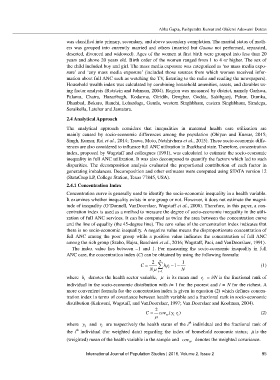
                                The  index value lies  between  –1 and 1. For measuring  the socio-economic inequality  in full
                             ANC care, the concentration index (C) can be obtained by using the following formula:
                                                                  2  n        1
                                                                           1
                                                             C =    ∑  hr −−                                    (1)
                                                                        ii
                                                                 Nµ i= 1      N
                             where  h   denotes the health sector variable,  µ   is its mean and  r   = i/N is the fractional rank of
                                                                                       i
                                     i
                             individual in the socio-economic distribution with i= 1 for the poorest and i = N for the richest. A
                             more convenient formula for the concentration index is given in equation (2) which defines concen-
                             tration index in terms of covariance between health variable and a fractional rank in socio-economic
                             distribution (Kakwani, Wagstaff, and VanDoorslaer, 1997; Van Doorslaer and Koolman, 2004).
                                                                   2
                                                               C =   cov w (y r                                  (2)
                                                                             )
                                                                           ii
                                                                   µ
                                                                                 th
                             where  y   and  r   are respectively the health status of the i  individual and the fractional rank of
                                     i
                                            i
                                 th
                             the i  individual (for weighted data) regarding the index of household economic status;  µ is the
                             (weighted) mean of the health variable in the sample and  cov   denotes the weighted covariance.
                                                                                  w
                                     International Journal of Population Studies | 2016, Volume 2, Issue 2      95

