


Page 68 - IJPS-2-2
P. 68
Transition in risks of higher order births in Nepal: a life table analysis

                                                                   ∑ bx
                                                                      i i
       present paper) or hazard rate h(t) at any time t is given by  ()ht =  h 0 ()t e  i  where, h 0(t) is the base-
       line hazard function when the x i are set equal to zero and indicates the expected risk of failure with
       the explanatory variables set at zero; x i are explanatory variables and b i are the coefficients to be es-
       timated in the model.
         The study is  based on  cross-sectional database and it  does  not  capture how individuals might
       have changed their fertility behavior through time. This inherent limitation of cross-sectional data
       over panel data is a limitation of this paper.
       3. Results

       3.1 The First Birth and Birth Intervals

       The median age at first birth in Nepal was almost constant over the period 1996–2011. More than 85%
       of women of different age cohorts had their first birth before age 25; the median age at first birth for
       women ages 25–49 was around age 20 in 2011 (MOHP, New ERA, and ICF International, 2012;
       MOHP, New ERA and Macro International, 2007; MOH, New ERA and ORC Macro, 2002; Pradhan,
       Aryal, Regmi,  et al.,  1997).  The median age at first birth for different age cohorts of women in
       NDHS-2011 is shown in Table 1. The results show little variation in the median age at first birth for
       different  cohorts of women. The median age  at first  birth  is around age 20 for  all age cohorts.
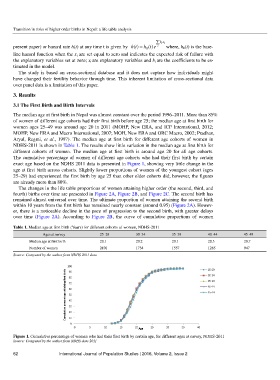
       The cumulative percentage of women of different age cohorts who had their first birth by certain
       exact age based on the NDHS 2011 data is presented in Figure 1, showing very little change in the
       age at first birth across cohorts. Slightly lower proportions of women of the youngest cohort (ages
       25–29) had experienced the first birth by age 25 than other older cohorts did; however, the figures
       are already more than 80%.
         The changes in the life table proportions of women attaining higher order (the second, third, and
       fourth) births over time are presented in Figure 2A, Figure 2B, and Figure 2C. The second birth has
       remained almost universal over time. The ultimate proportion of women attaining the second birth
       within 10 years from the first birth has remained nearly constant (around 0.95) (Figure 2A). Howev-
       er, there is a noticeable decline in the pace of progression to the second birth, with greater delays
       over  time (Figure  2A). According to  Figure 2B,  the  curve of cumulative  proportions of women

       Table 1. Median age at first birth (Years) for different cohorts of women, NDHS-2011
                   Ages at survey           25–29          30–34          35–39          40–44           45–49
             Median age at first birth      20.1           20.2           20.1           20.3            20.7
             Number of women                2101           1734           1557           1285            947
       Source: Computed by the author from NDHS 2011 data


       Figure 1. Cumulative percentage of women who had their first birth by certain age, for different ages at survey, NDHS-2011
       Source: Computed by the author from NDHS data 2011

       62                 International Journal of Population Studies | 2016, Volume 2, Issue 2

